

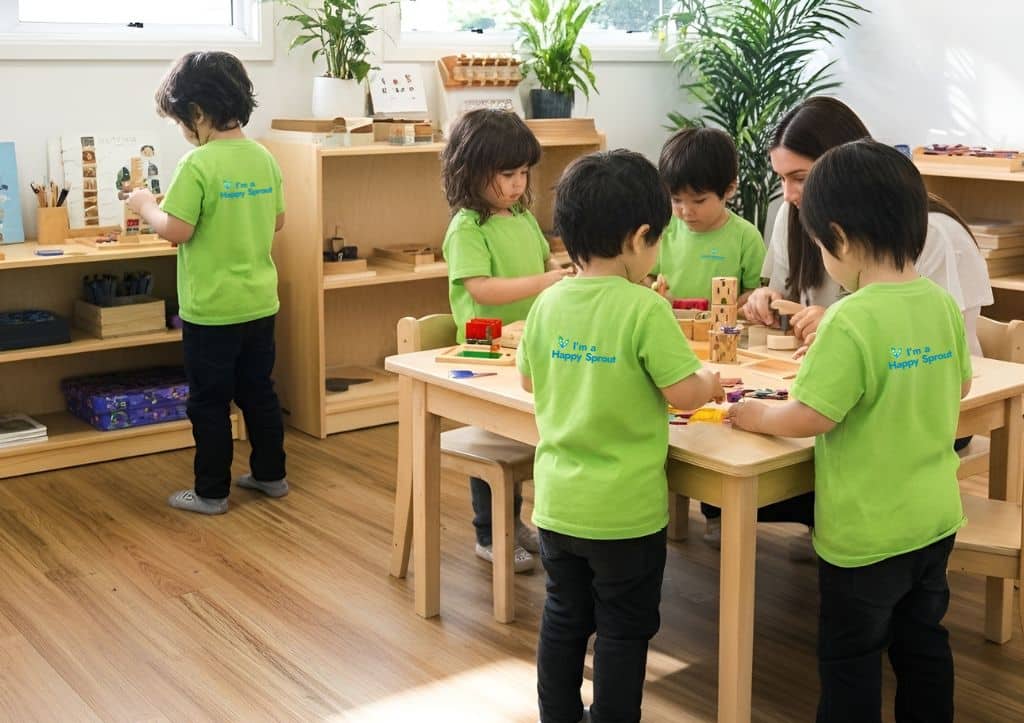
Play is not a break from learning in early childhood; play is the learning. Play-based learning in early childhood is the most well-researched, widely endorsed approach to early education, and it is the foundation of Australia’s Early Years Learning Framework (EYLF). Children who learn through play develop stronger cognitive, language, physical, and social-emotional skills than those in formal, structured instruction, and they do it in a way that is intrinsically motivating, developmentally appropriate, and deeply joyful.
Play-based learning is a pedagogical approach in which children explore, discover, and make sense of the world through play. It is child-centred, meaning a child’s interests, questions, and natural curiosity drive the experience, not a rigid curriculum or adult agenda.
It exists on a spectrum:
Quality early childhood programmes blend all three, creating environments where children feel safe to take risks, make mistakes, and revisit ideas.
The years from birth to age eight represent the most significant period of brain development in a person’s life. During this window, the brain forms neural connections faster than at any other time, connections that underpin thinking, language, movement, and social behaviour.
Play is the mechanism through which young children build those connections:
What the research says:

Play-based learning supports development across every domain. Here is how it works across the five key areas:
Play-based learning supports cognitive development by giving children repeated, hands-on opportunities to explore cause and effect, pattern, quantity, and sequence all in a low-stakes, self-motivated context. Children form schemas (mental frameworks), test hypotheses, and develop executive function skills, including attention, working memory, and cognitive flexibility.
Play is a language-rich environment. Children narrate their play, negotiate with peers, ask questions, and listen all in meaningful contexts. Dramatic play exposes children to a wide vocabulary range, and storytelling builds early literacy skills.
Research shows children develop stronger early literacy skills when language is embedded in meaningful experience, not drilled in isolation.
Activities central to play, drawing, painting, threading beads, using scissors, manipulating playdough, and building with small blocks develop the hand-eye coordination, grip strength, and precise muscle control children need for writing.
Play-based learning develops these skills naturally and enjoyably, building the physical foundations for independence in school and daily life.
Active outdoor play, climbing, digging, dancing, and balancing strengthen large muscle groups that underpin physical health, coordination, and body awareness. Sensory play exploring water, mud, and textured materials further develops gross motor skills alongside sensory processing.
When children play together, they practise empathy, perspective-taking, self-regulation, cooperation, and conflict resolution – the skills most predictive of long-term success in school and life.
Imaginative play is particularly powerful: when a child plays the role of a doctor, teacher, or shopkeeper, they are practising what it feels like to be someone else, building the theory of mind that underlies all meaningful relationships.

Imaginative play, also called dramatic or symbolic play, is one of the richest learning contexts available to young children. When children take on roles, create scenarios, and use objects to represent other things, they develop creativity, narrative thinking, vocabulary, and problem-solving.
A simple dress-up box and a few props generate hours of complex play spanning multiple developmental domains simultaneously.
Sensory play involves exploring materials through sight, touch, smell, sound, and sometimes taste. Water, sand, playdough, mud, slime, and sensory bins. It supports:
Both have a place in quality early childhood education.
| Structured Play | Unstructured Play | |
|---|---|---|
| Who leads | Educator-initiated | Child-led |
| Goal | Intentional learning objective embedded | Child-determined |
| Value | Scaffolds specific skills and concepts | Builds agency, intrinsic motivation, creativity |
| Example | Sensory bin set up to explore measurement | Free building with blocks |
The best play-based programmes move fluidly between both reading children’s cues and extending learning without taking over the experience.
Australia’s Early Years Learning Framework (EYLF) Belonging, Being and Becoming explicitly recognises play-based learning as the most effective pedagogy for children from birth to five years. It underpins the National Quality Framework (NQF) that governs all approved early childhood education and care services in Australia.
The EYLF states that play “provides opportunities for children to learn as they discover, create, improvise and imagine”. It supports all five EYLF learning outcomes:
At Happy Sprouts, our play-based approach is built directly on the EYLF, not as a compliance exercise, but as a lived philosophy embedded in how we design our environments, plan our programmes, and support each child’s learning journey.
Play-based learning is not the absence of structure; it is a different kind of structure. Here is how it compares to traditional, teacher-directed learning:
| Play-Based Learning | Traditional Learning | |
|---|---|---|
| Led by | Child’s interests and curiosity | Teacher/curriculum |
| Style | Experiential, hands-on | Passive, abstract |
| Motivation | Intrinsic | External (grades, praise) |
| Scope | Holistic — multiple domains at once | Subject-segmented |
| Flexibility | Responsive to the child | Fixed |
| Best for | Birth to age 8 | Later formal schooling |
Young children are not neurologically ready for passive, formal instruction. Play-based learning aligns with how their brains are actually wired to learn, which is why the EYLF recommends it so strongly.
At Happy Sprouts, play-based learning is embedded in every aspect of our programme and environment.
Our educators are trained to observe children’s play with purpose, identifying learning opportunities and extending them through careful questioning, new materials, or thoughtfully designed provocations. Our indoor and outdoor environments invite exploration, encourage risk-taking, and support development across all domains.
Whether it is a mud kitchen in the garden, a construction corner stocked with loose parts, a dramatic play space, or a quiet reading nook, every element of the Happy Sprouts environment has been chosen to support children’s growth through play.
Our programme is fully aligned with the EYLF and NQF, and our educators undergo continuous professional development to ensure our approach reflects the best available research and practice.
Find out more about our play-based approach or enquire about enrolment today.
Play-based learning does not stop at the centre gate. Here are practical ways to extend it at home:
Ready to see play-based learning in action? Book a tour of Happy Sprouts or enquire about enrolment today.
Play-based learning in early childhood is a pedagogical approach in which children learn through play, exploring, creating, imagining, and problem-solving in child-centred environments. It is the approach recommended by Australia’s Early Years Learning Framework (EYLF) for children from birth to age five, and it is the foundation of the Happy Sprouts programme.
Play is the primary vehicle for learning in early childhood. It builds cognitive, language, fine motor, gross motor, and social-emotional development simultaneously, and it does so in a way that is intrinsically motivating and developmentally aligned with how young children’s brains are wired to grow.
Play-based learning develops problem-solving and critical thinking, builds language and early literacy, strengthens fine and gross motor skills, fosters empathy and social skills, and supports school readiness all while keeping children engaged and motivated through natural curiosity.
Play gives children hands-on opportunities to form mental frameworks (schemas), test hypotheses, and explore concepts like pattern, quantity, and cause and effect. It also builds executive function, attention, working memory, and cognitive flexibility that underpins academic learning in later years.
Unstructured play is entirely child-led with no adult agenda. Structured play involves educator-initiated activities with intentional learning goals embedded. Both have value; quality early childhood programmes like Happy Sprouts use a blend of both alongside guided play, where educators introduce a provocation and then step back to observe and extend.
Through play, children practise negotiation, cooperation, turn-taking, empathy, and conflict resolution. Imaginative play in particular builds theory of mind, the ability to understand that others have different thoughts and feelings, which is foundational to all social relationships.
The EYLF (Early Years Learning Framework) recognises play-based learning as the most effective pedagogy for children from birth to five. It states that play “provides opportunities for children to learn as they discover, create, improvise and imagine”, and it underpins all five EYLF learning outcomes. Learn how Happy Sprouts implements the EYLF.
Choose open-ended toys, create a safe play space, follow your child’s lead rather than directing play, get outside daily for nature play, and read together regularly. Ask open-ended questions to extend your child’s thinking without taking over the experience.
Examples of play-based learning activities include building with blocks, playdough and clay work, water and sand play, dramatic and pretend play, nature walks and outdoor exploration, art and craft, music and movement, puzzles and construction, cooking and baking, and collaborative group projects. At Happy Sprouts, these experiences are designed intentionally to align with each child’s developmental stage.
Transition to school is the process of moving a child from kindergarten into the first year of prima[...]
Early childhood services are the regulated education and care options available for children from bi[...]
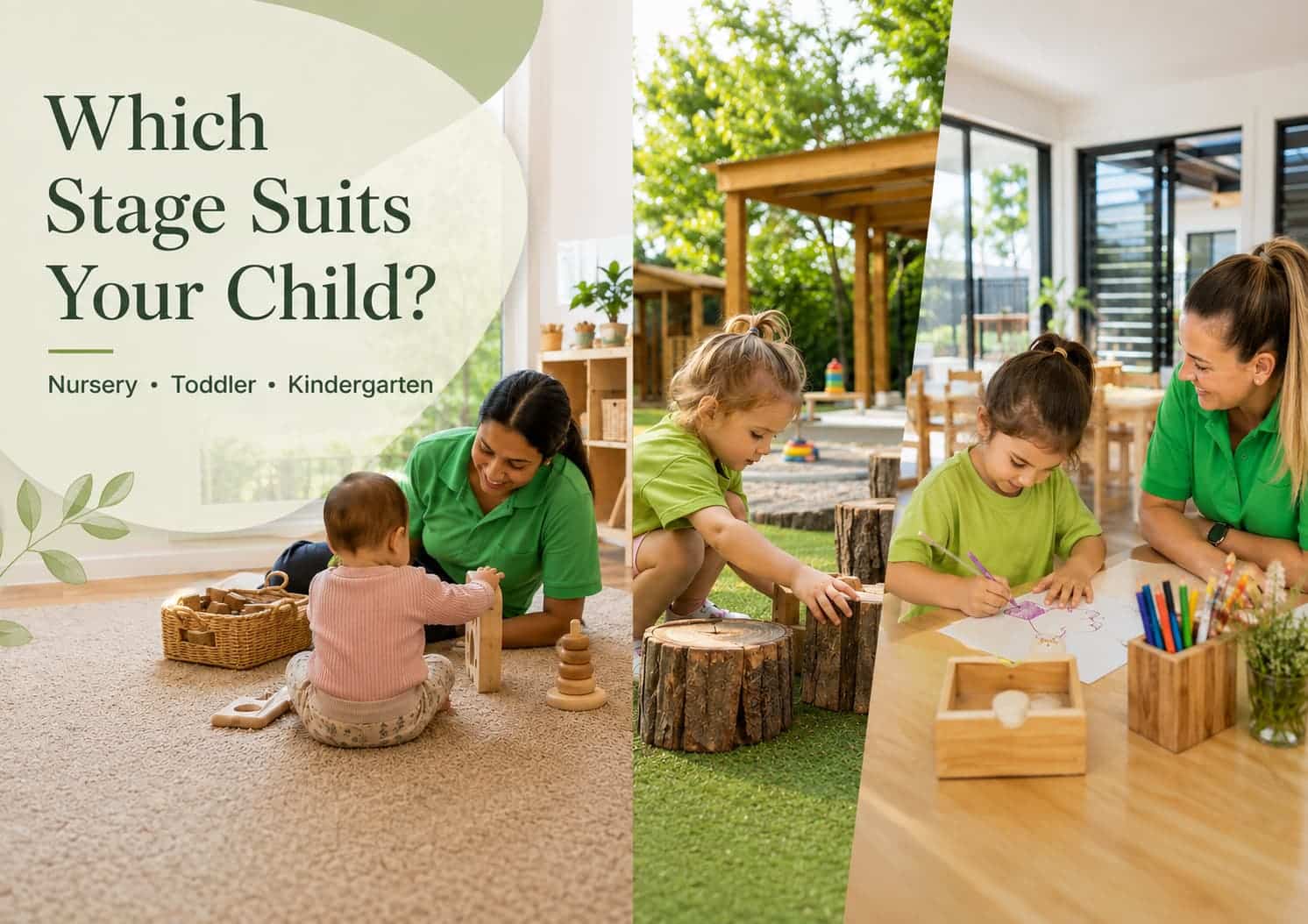
Nursery programs suit babies from approximately six weeks. Toddler programs suit children from aroun[...]
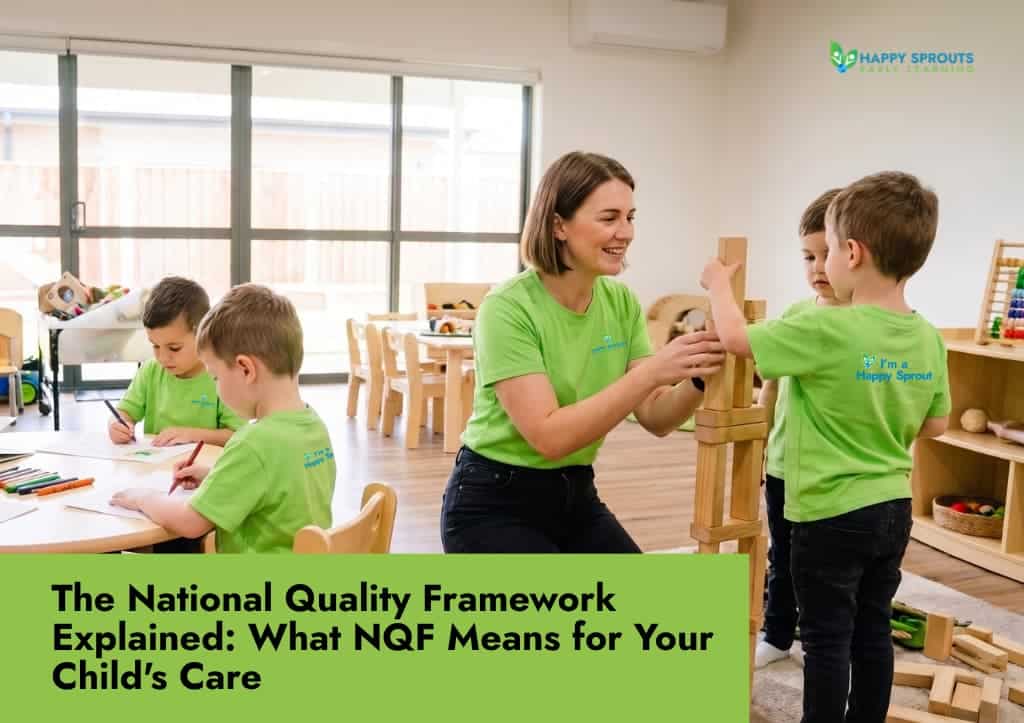
Quick answer The National Quality Framework (NQF) is Australia's national system for regulating a[...]
Childcare and kindergarten aren't the same thing. Childcare (or long day care) offers all-day [...]
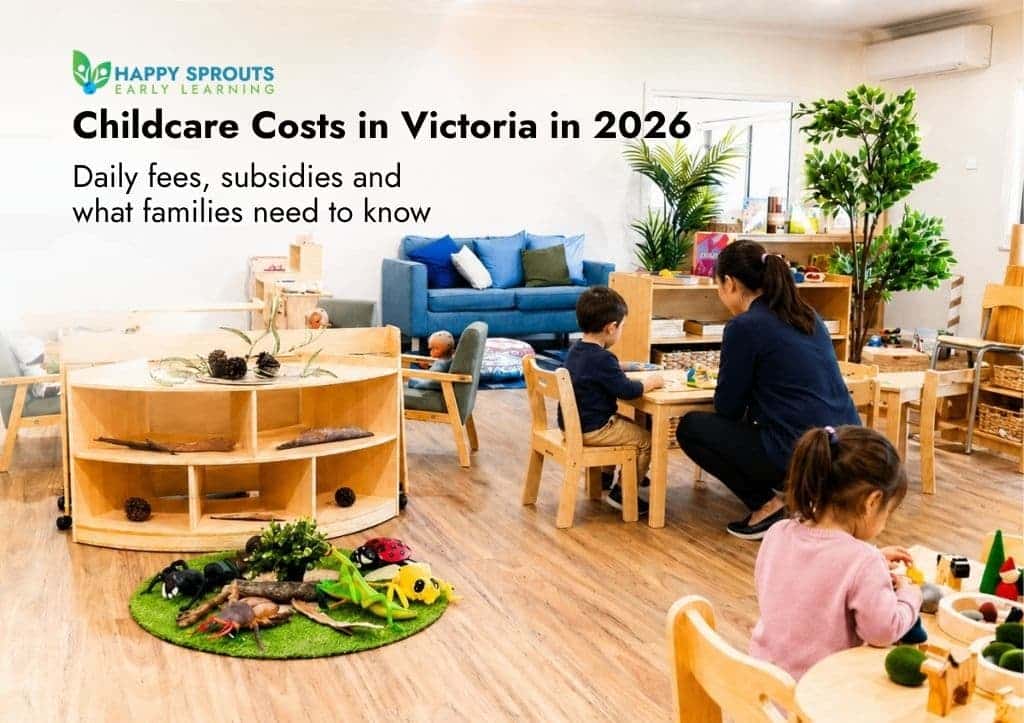
Childcare in Victoria in 2026 is more affordable than ever for most working families, thanks to the [...]