

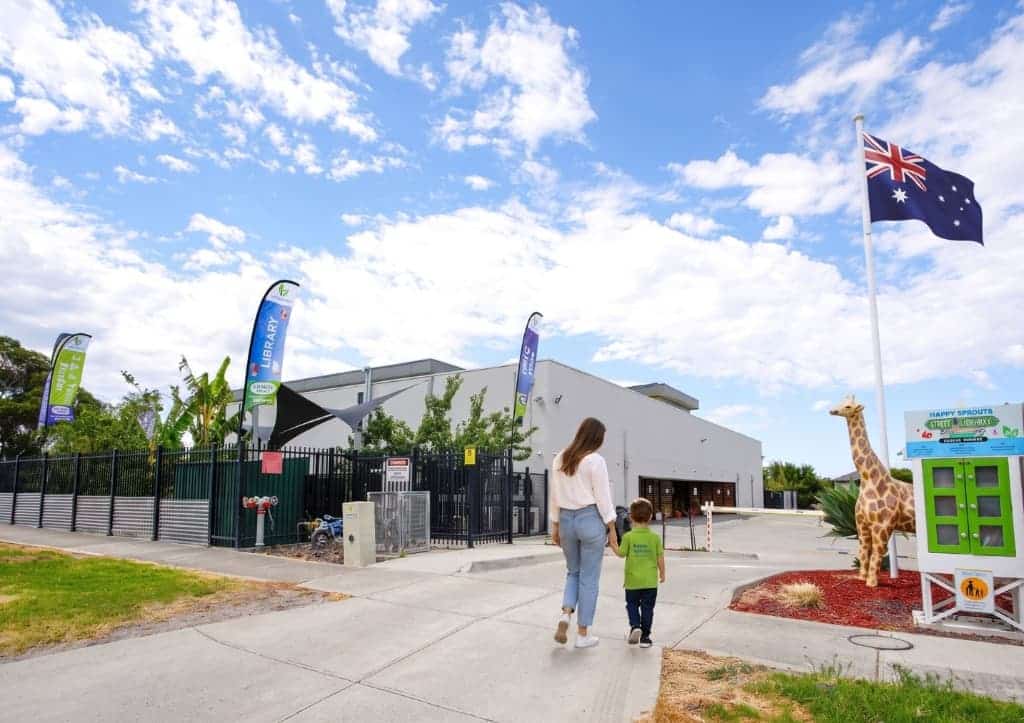
| Childcare and kindergarten aren’t the same thing. Childcare (or long day care) offers all-day care and learning for children 6 weeks to 6 years, built around working families. Kindergarten is a structured, teacher-led early childhood education programme in the year or two before school, focused on school readiness. Many centres, including Happy Sprouts, offer both. |
The simplest way to hold the difference in your head: childcare is mostly care with learning built in, while kindergarten is mostly learning with care built in. In practice, they overlap, and at many centres your child gets both at once.
| Childcare (long day care) | Kindergarten (kinder) | |
|---|---|---|
| Ages | 6 weeks – 6 years | Mainly 3–5 years |
| Hours | Full days, most of the week | Set sessions, fewer hours |
| Main focus | Care, wellbeing & play-based learning | School readiness, literacy & numeracy |
| Led by | Qualified educators | A qualified kinder teacher |
| Best for | Working families needing all-day care | Preparing children for school |
| Cost help | Child Care Subsidy | Government-funded kinder |
Explore how both sit inside our approach on the Our Curriculum page.

Childcare is professional care and early learning for young children while parents work or study. It runs long days, covers a wide age range, and blends everyday care routines with play-based learning. At Happy Sprouts, our centres care for children from 6 weeks to 6 years across Craigieburn, Beveridge and Greenvale.
Good childcare does far more than supervise. Educators support each child’s social-emotional development, language and physical growth through play, all guided by the Victorian Early Years Learning and Development Framework (VEYLDF).
Childcare spans the whole early-years range. Babies start in a nursery, then move through toddler rooms as they grow more independent. See our Nursery & Walkers Rooms and Toddler Rooms.
This is one of the biggest practical differences. Long day care opens early and closes late, most days of the week. Kindergarten runs shorter, set sessions. If you need care that covers a full working day, childcare is usually the answer. Childcare in Australia is regulated by ACECQA under the National Quality Framework.
Kindergarten is a structured educational programme for children in the years just before school, led by a qualified kinder teacher. It builds early literacy, numeracy and thinking skills through guided, play-based experiences. In Victoria, kinder is government funded, so it can be free or low-cost for eligible families, and it aligns with the VEYLDF’s “Belonging, Being, Becoming” approach.
There are two kinder years. Children usually start 3-year-old kinder the year they turn three, and 4-year-old kinder the year before they begin primary school. The 4-year-old year has a stronger school-transition focus. See our 3 Year Old Kinder Rooms and 4 Year Old Kinder Rooms.
Sessional kinder is kindergarten delivered in set sessions rather than as full-day care. Our Sessional Kinder programme runs 2 or 3 days a week, taught by a qualified kinder teacher, with no out-of-pocket cost for CCS-approved families.
Yes, and this is where the two worlds meet. Many long day care centres run a funded kinder programme inside the centre, so your child gets structured kinder learning and full-day care in the same place. You don’t have to choose one or the other.
| The best of both: At Happy Sprouts, families can access childcare and a funded kinder programme delivered by a qualified teacher, the school readiness benefits of kinder, wrapped inside the convenience of long day care. See Our Education and our Program page. |
Both help, in different ways. Quality childcare builds the social skills, confidence and routines school demands. A dedicated kinder or school readiness programme adds the structured literacy, numeracy and thinking practice that prepares a child for the classroom. Both use play-based learning aligned with the VEYLDF. See our School Readiness Program and Child Development pages.

Childcare fees can be reduced through the Child Care Subsidy, a government payment that lowers what eligible families pay per hour. Kinder is funded separately, which is why funded kinder can be free or very low-cost. Our funded sessional kinder carries no out-of-pocket cost for CCS-approved families. Estimate your fees with our Child Care Subsidy guide and calculator.
Start with two questions: how old is your child, and how many hours of care do you need? If you need all-day care across the week, childcare is the practical base. If your child is 3 or 4 and you want a focused run-up to school, add kinder as sessional kinder or inside a long day care centre.
When you’re ready, our Transitioning to Childcare and Getting Started pages walk you through settling in and enrolling. The best next step is to see a centre in person and book a tour at Craigieburn, Beveridge or Greenvale.
A: No. Daycare (childcare) provides all-day care across a wide age range, while kindergarten is a structured, teacher-led programme in the one or two years before school.
A: Most children start 3-year-old kinder the year they turn three, and 4-year-old kinder the year before they begin primary school.
A: Yes. Many long day care centres, including Happy Sprouts, run a funded sessional kinder programme delivered by a qualified kinder teacher.
A: Funded kinder can be free or low-cost for eligible families. Our funded sessional kinder has no out-of-pocket cost for CCS-approved families.
A: Yes. Both use play-based learning aligned with the VEYLDF, though kinder places extra focus on literacy, numeracy and school readiness.
A: Both help, but a dedicated kinder or school readiness programme is designed specifically to prepare children for the transition to school.

Sessional kinder is a free, teacher-led kindergarten program for three- and four-year-old in Victori[...]
Playgroup benefits for toddlers include stronger social skills, early language, emotional confidence[...]
Transition to school is the process of moving a child from kindergarten into the first year of prima[...]
Early childhood services are the regulated education and care options available for children from bi[...]
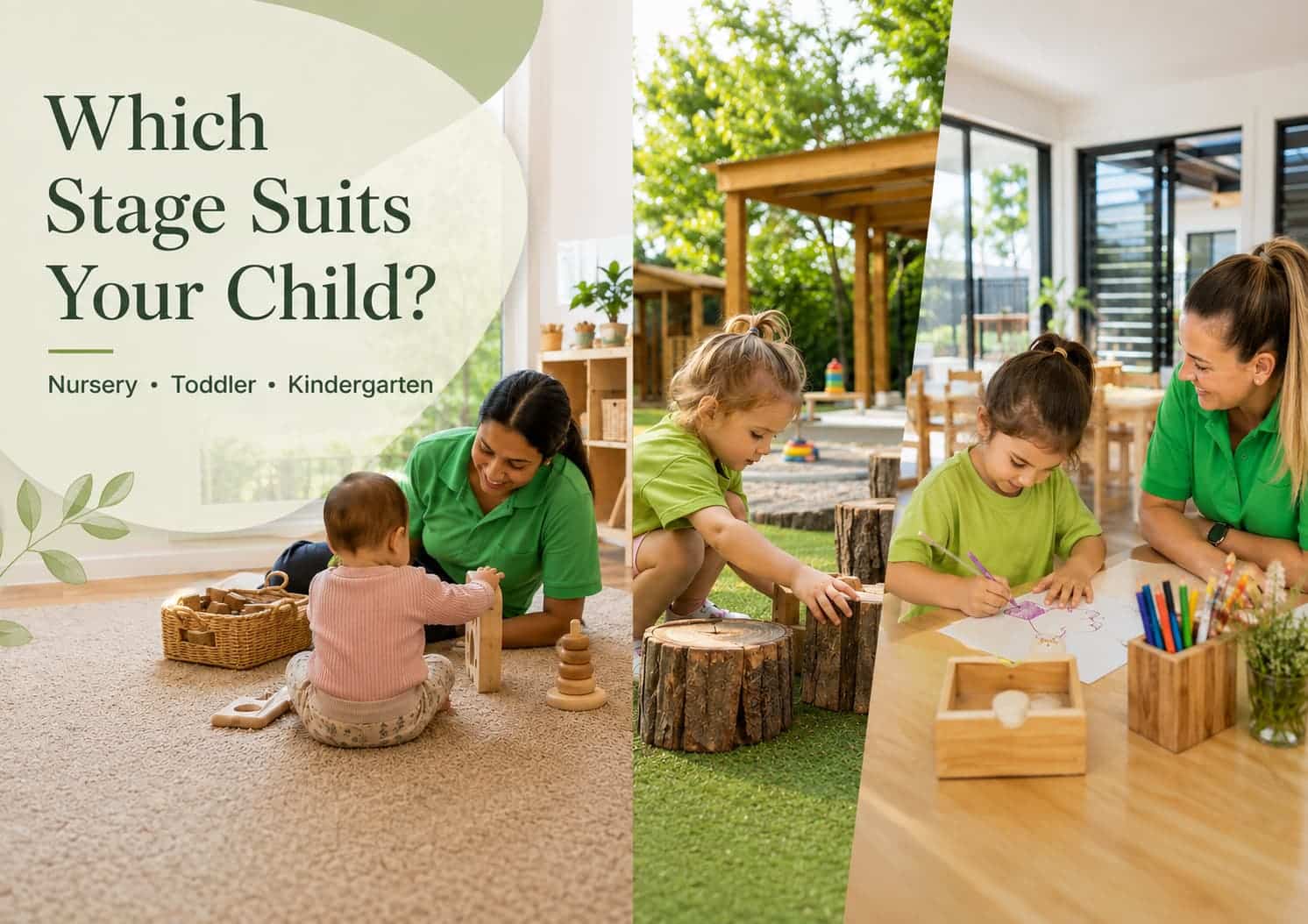
Nursery programs suit babies from approximately six weeks. Toddler programs suit children from aroun[...]
Quick answer The National Quality Framework (NQF) is Australia's national system for regulating a[...]