


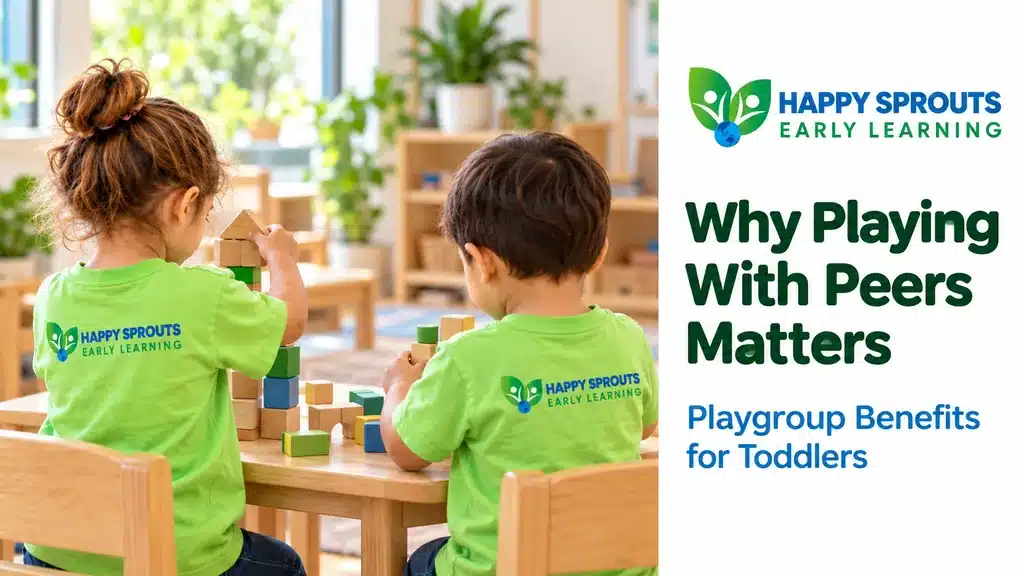
Playgroup benefits for toddlers include stronger social skills, early language, emotional confidence and an easier start in childcare and kinder. A playgroup is a regular, informal session where parents or carers stay and play with their children under school age. Peer play, which means playing with children of a similar age, lets toddlers watch, copy and practise sharing with a trusted adult nearby.
Key Takeaways
- The benefits of playgroup cover five areas: social, emotional, language, thinking and physical development.
- Parallel play, where toddlers play side by side without joining in, is a normal stage commonly seen around two to three years.
- The six stages of play move from solitary play to parallel play, to cooperative play with shared goals.
- At playgroup, parents stay and lead. In childcare, qualified educators deliver a planned learning program.
- Families can find a local playgroup through Playgroup Victoria or their Maternal and Child Health (MCH) nurse.
A playgroup is a group of children from birth to school age and their parents or carers who meet regularly to play together. Parents and carers stay for the whole session and remain responsible for their own child. Playgroups meet in community centres, halls, libraries, schools, early learning centres and parks.
Most Victorian playgroups fall into three types. Use this table to see which might suit your family.
| Type | Who runs it | Who it suits | Cost |
|---|---|---|---|
| Community playgroup | Parents, usually as volunteers | Any family with a child under school age | Often a small fee to cover costs such as venue hire and insurance |
| Supported playgroup | A qualified facilitator | Families who need extra support; eligibility applies | Free |
| Themed playgroup | Parents or a facilitator | Shared interests, such as nature, music, dads or first-time parents | Varies by group |
Playgroup benefits toddlers in five areas: social, emotional, language, thinking and physical development. The table shows what toddlers practise in each area and how it looks in a typical session.
| Area | What toddlers practise | At playgroup |
|---|---|---|
| Social | Sharing, turn-taking, early friendships | Waiting for a turn on the slide |
| Emotional | Confidence, belonging, coping with frustration | Settling into a familiar group each week |
| Language | New words, songs, rhymes, simple conversations | Chatting with another child at snack time |
| Thinking | Problem solving, imagination, curiosity | Working out how a shape sorter fits together |
| Physical | Fine and gross motor skills | Kicking a ball or carrying toys to a friend |
Playing with peers matters because toddlers learn social behaviour by practising it with other children, not by being told. Four relationships explain why:
Toddlers aged two to three still need supervision and help with sharing and problem-solving, so a nearby parent or educator makes peer play work.
Parents benefit too. Playgroup connects parents and carers with local families, reduces isolation and offers a relaxed place to share ideas. Parents also model positive social behaviour, such as greeting others and taking turns, which toddlers copy.
Playgroups usually offer five main types of play, and each builds different skills. Use the table to see what your toddler gains from each.
| Type of play | Examples | Skills it builds |
|---|---|---|
| Pretend play | Home corner, dress-ups, toy kitchens | Imagination, language and understanding others |
| Sensory and messy play | Playdough, sand, water, painting | Fine motor skills and curiosity |
| Construction play | Blocks, stacking cups, simple puzzles | Problem solving and hand-eye coordination |
| Music and movement | Songs, rhymes, action games | Listening and early literacy |
| Outdoor play | Climbing, running, sandpits, balls | Gross motor skills and confidence |
The stages of play are six steps in how children learn to play with others: unoccupied, solitary, onlooker, parallel, associative and cooperative play. Children progress from playing alone, to playing alongside others, to playing together with shared goals. Sociologist Mildred Parten described these stages in 1932, and early childhood educators still use them today.
| Stage | What it looks like | Commonly seen |
|---|---|---|
| Unoccupied | Watching, moving and exploring without a clear game | Babies |
| Solitary | Playing alone with own toys | Babies and young toddlers |
| Onlooker | Watching other children play without joining in | Toddlers |
| Parallel | Playing beside another child with similar toys, without joining their game | Around 2 to 3 years |
| Associative | Sharing toys and talking, but without a shared plan | Around 3 to 4 years |
| Cooperative | Playing together towards a shared goal, with roles and rules | Around 4 years and older |
Ages are a guide only. Children move between stages and develop at their own pace.
Yes. Parallel play is a normal and important stage for toddlers. Two toddlers building separate towers side by side are still learning from each other: they watch, copy ideas and get used to sharing space. This side-by-side play is the foundation for cooperative play later.
The main difference is who stays and who teaches. At playgroup, parents stay and lead their child’s play. In childcare, qualified educators deliver a planned, play-based program while parents are away. Compare the two settings below.
| Feature | Playgroup | Childcare toddler program |
|---|---|---|
| Who stays | Parent or carer stays for the whole session | Parent drops off; educators care for the child |
| Who leads | Parents or a facilitator | Qualified early childhood educators |
| Learning program | Informal free play, songs and craft | Planned program guided by the Early Years Learning Framework (EYLF) and its Victorian version (VEYLDF) |
| How often | Regular sessions, often weekly | One or more full or part days each week |
| Regulation | Not a regulated education and care service | Regulated under the National Quality Framework |
| Best for | Families wanting shared play and local connection | Families needing care and regular peer learning |
Many families use both. Playgroup can be a first taste of group play, and a toddler program offers peer play every week in a consistent setting.
Toddlers can attend playgroup from birth, because a parent stays. For childcare, readiness depends more on settling routines than age. Talk with the centre about orientation visits, and speak with your Maternal and Child Health (MCH) nurse if you have concerns about your toddler’s social development.
Happy Sprouts Early Learning does not run playgroups. Our Toddler Program, for children aged two to three, helps toddlers develop social-emotional connections with their peers, with social skills coaching, language development and hands-on indoor and outdoor discovery.
Our toddler rooms include a reading corner, an art and craft area, an imaginative play area and a social and meeting area. Outdoors, toddlers share a sandpit, cubby house, open play area and early outdoor climbing resources. Play is the foundation of learning, and our programs follow each child’s emerging interests. Learn more about our philosophy and our toddler rooms.
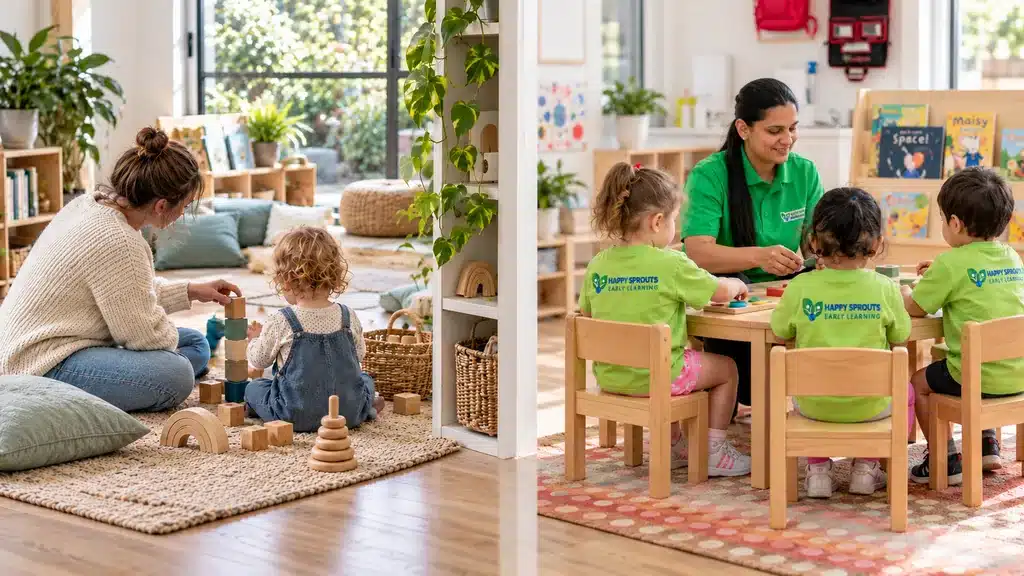
Shy toddlers join in more easily when they can watch first and move closer at their own pace. Pushing a toddler into play often makes them hold back further.
Regular play with other children helps toddlers grow socially, emotionally and in their language, whether through a weekly playgroup, a toddler program or both. Start with short, familiar sessions and let your toddler join in at their own pace. To see how toddlers play and learn together, book a tour at Happy Sprouts Early Learning in Craigieburn, Greenvale or Beveridge.
Search the Find a Playgroup tool on the Playgroup Victoria website, or ask your MCH nurse or local council. In Hume, local libraries and community centres are good places to ask about nearby groups and supported playgroups.
Toddlers do not need formal socialising before kinder, but regular play with peers helps. Children who are used to group play often find sharing space, waiting and following group routines at kinder less overwhelming.
No. Sharing is still developing at this age. Toddlers often find it hard to give up a toy, and adults can help by offering turns, using a timer or having more than one of a popular toy.
Transition to school is the process of moving a child from kindergarten into the first year of prima[...]
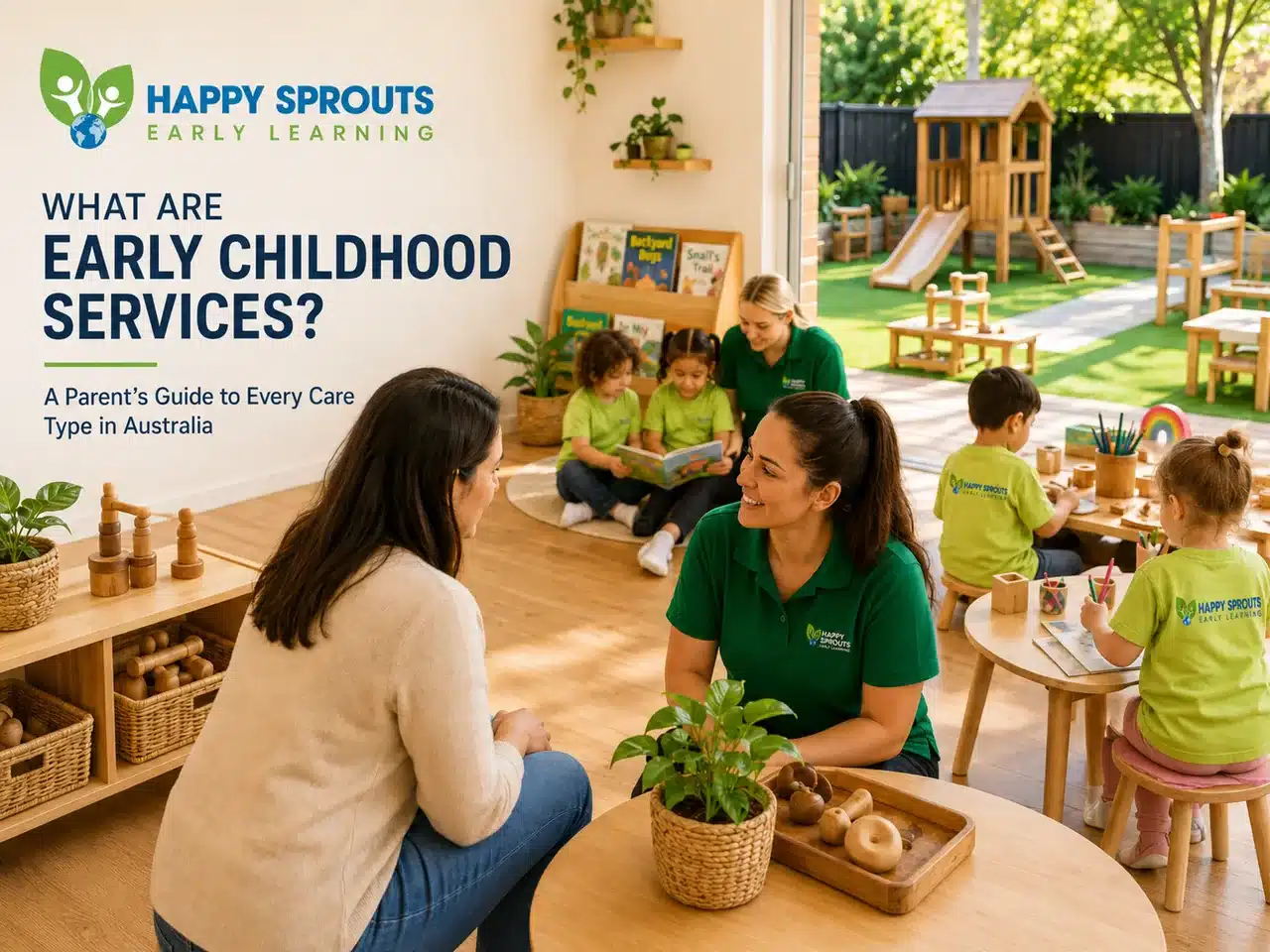
Early childhood services are the regulated education and care options available for children from bi[...]
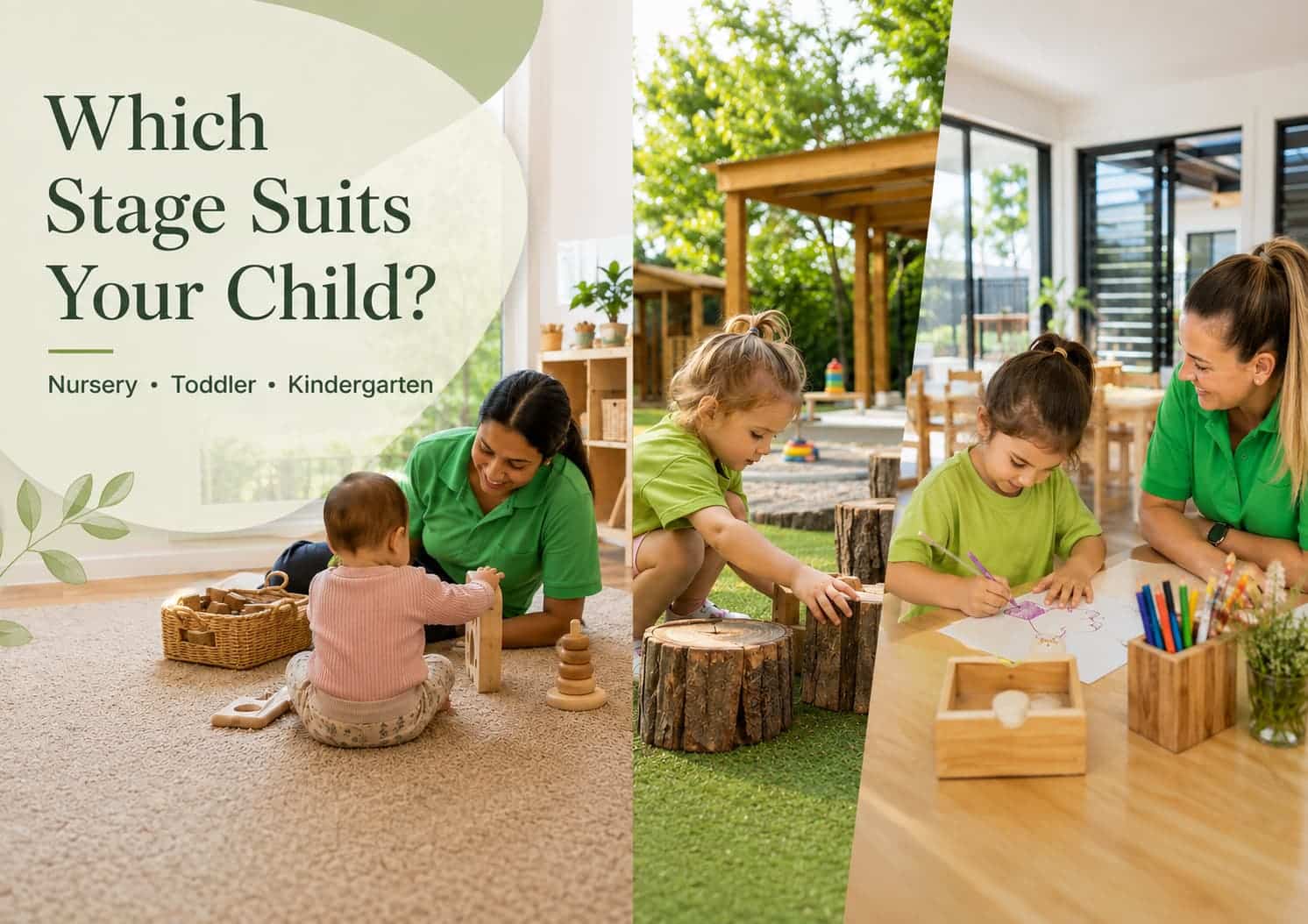
Nursery programs suit babies from approximately six weeks. Toddler programs suit children from aroun[...]
Quick answer The National Quality Framework (NQF) is Australia's national system for regulating a[...]
Childcare and kindergarten aren't the same thing. Childcare (or long day care) offers all-day [...]
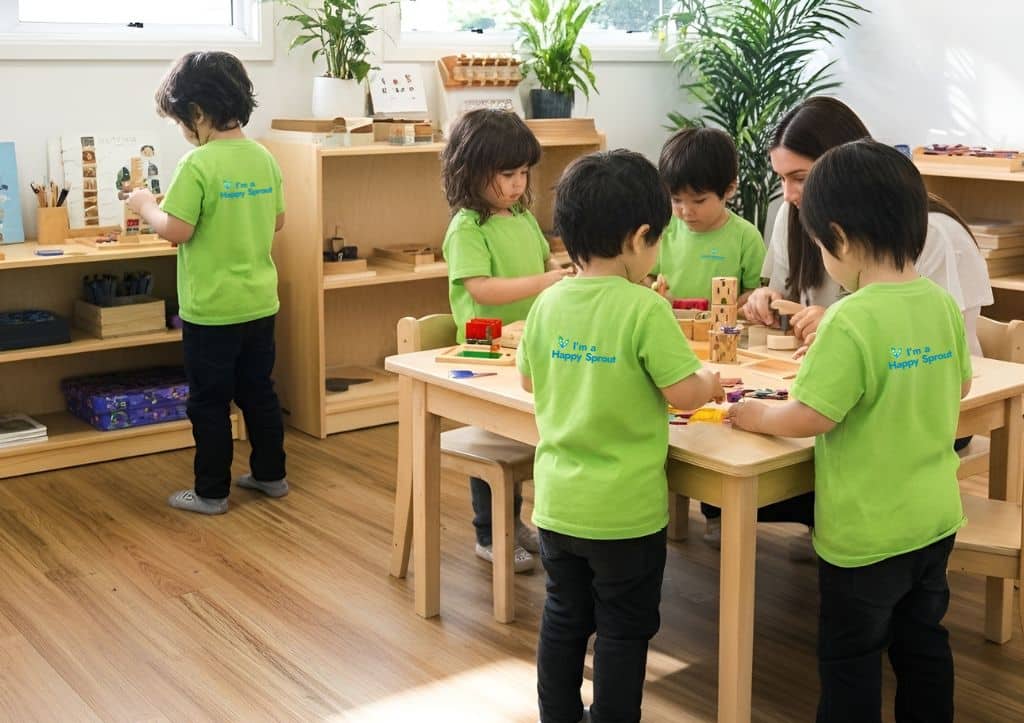
Play is not a break from learning in early childhood; play is the learning. Play-based learning in e[...]