

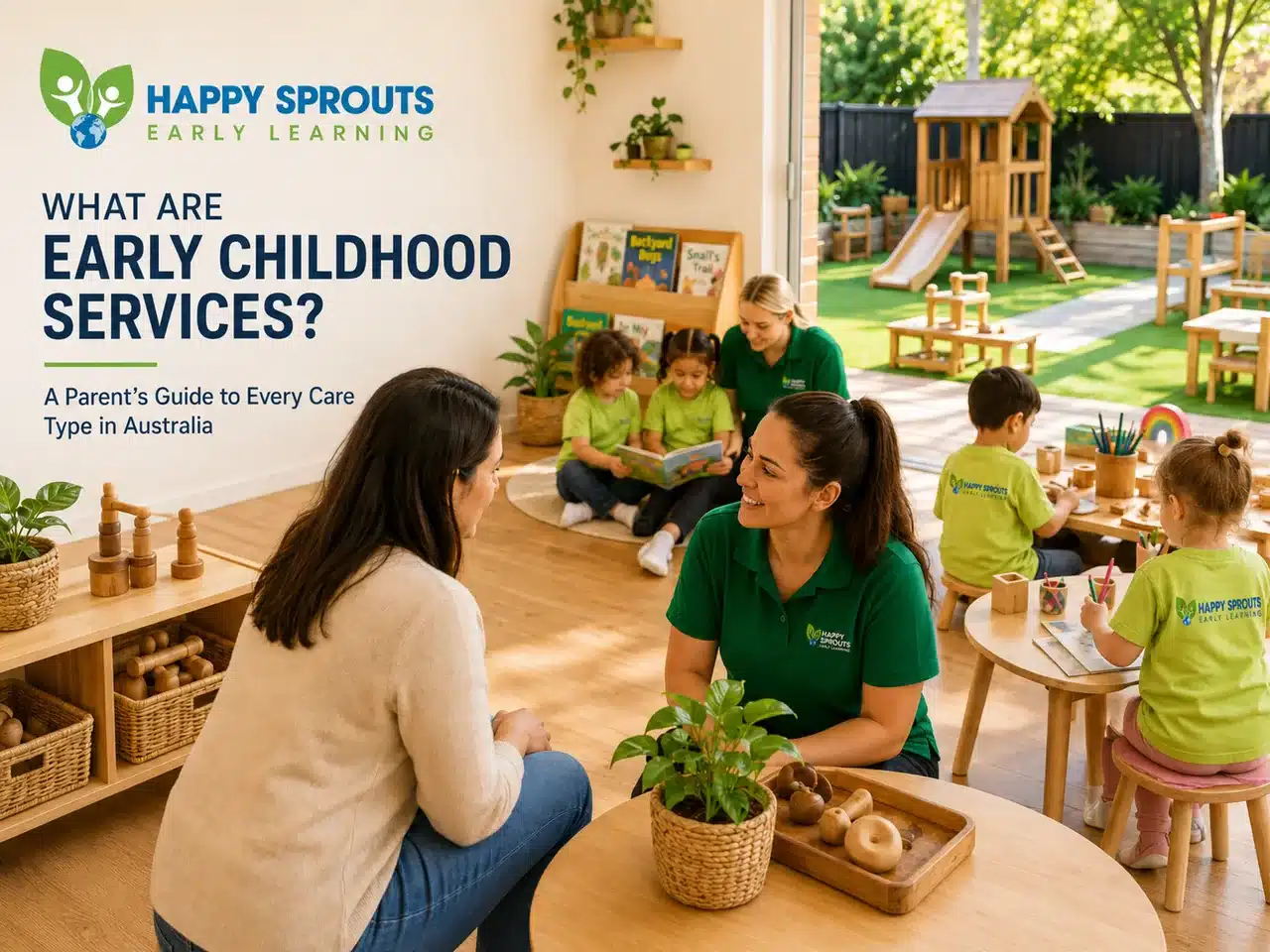
Early childhood services are the regulated education and care options available for children from birth to 13 years in Australia. The main types are long day care, family day care, preschool and kindergarten, occasional care, outside school hours care and in-home care. All approved services operate under the National Quality Framework, and most are eligible for the Australian Government’s Child Care Subsidy.
Six main types of early childhood services exist in Australia — long day care, family day care, preschool/kindergarten, occasional care, outside school hours care and in-home care.
Long day care is the most common service type — providing full-day education and care for children from birth to school age in a centre-based setting.
Family day care is delivered in an educator’s own home — in smaller groups, suited to families who prefer a home-like environment.
Kindergarten and preschool are the same stage under different names — Victoria uses “kindergarten,” while other states may use “preschool” or “pre-primary.”
The National Quality Framework regulates all approved services — ACECQA oversees quality assessment and rating across seven quality areas.
The Child Care Subsidy helps families reduce out-of-pocket costs — from January 2026, all eligible families receive at least 72 hours of subsidised care per fortnight (the 3 Day Guarantee).
Victorian Free Kinder funds kindergarten for all three- and four-year-olds — regardless of family income, citizenship or visa status.
Starting Blocks is the free government tool for comparing services — families can search by location, view quality ratings and estimate out-of-pocket costs.
Australia has six main types of regulated early childhood services, each designed for different ages, family situations and care needs. All approved services operate under the Education and Care Services National Law and are assessed against the National Quality Standard by ACECQA, the Australian Children’s Education and Care Quality Authority.
| Service Type | Setting | Age Range | Typical Hours | CCS Eligible |
|---|---|---|---|---|
| Long day care | Centre-based | Birth to 6 years | 6:00 am–6:30 pm weekdays | Yes |
| Family day care | Educator’s home | Birth to 13 years | Flexible; set by educator | Yes |
| Preschool / Kindergarten | Centre or school | 3 to 5 years | 5–15 hours per week | Sessional: No; LDC-integrated: Yes |
| Occasional care | Centre-based | Birth to school age | Short sessions; irregular | Yes (if approved) |
| Outside school hours care | School or centre | 5 to 13 years | Before/after school; holidays | Yes |
| In-home care | Child’s own home | Birth to 13 years | Flexible | Yes |
| Mobile services | Varies (rural/remote) | Birth to school age | Scheduled visits | Varies |
Every approved service must deliver an educational program based on an approved learning framework. The national framework is the Early Years Learning Framework (EYLF), Belonging, Being and Becoming. In Victoria, services also follow the Victorian Early Years Learning and Development Framework (VEYLDF). Both frameworks are built on play-based learning where children develop skills through purposeful play rather than formal instruction.
To operate legally and receive government funding, a service must hold approved provider status under the Education and Care Services National Law. This means the service has been assessed by its state or territory regulatory authority and meets the requirements of the National Quality Framework.
In addition to the six main types, mobile early childhood services deliver education and care to communities in rural and remote areas where permanent centres are not available. Mobile services travel to different locations on a scheduled basis.
Long day care is a centre-based service providing full-day education and care for children from birth to six years. It is the most widely used early childhood service type in Australia. Centres typically operate from around 6:00 am to 6:30 pm on weekdays, and programs are guided by the Early Years Learning Framework, Belonging, Being and Becoming. Long day care is eligible for the Child Care Subsidy.
Long day care centres employ educators with Certificate III, Diploma and degree-level qualifications. Educator-to-child ratios are set by the National Regulations and vary by age group. For example, one educator to four children for babies under 24 months, and one to 11 for children over 36 months.
Many long day care centres also deliver funded kindergarten programs for three- and four-year-old children, meaning families can access care and kinder in one location. Learn more about the difference between childcare and kindergarten.
Family day care is an approved education and care service delivered in the educator’s own home, in small groups of up to four children under school age (or up to seven children total including school-age children). It is regulated under the same National Quality Framework as centre-based services and is eligible for the Child Care Subsidy.
Family day care suits families who prefer a home-like environment, need flexible hours or live in areas where centre-based services are limited. Educators are supported by a family day care coordination unit, which monitors quality, provides resources and ensures compliance with national standards.
| Feature | Long Day Care | Family Day Care |
|---|---|---|
| Setting | Purpose-built centre | Educator’s home |
| Group size | Larger groups by age | Up to 4 preschool children per educator |
| Hours | Set operating hours (e.g. 6 am–6:30 pm) | Flexible; negotiated with educator |
| Curriculum | EYLF; may include funded kinder | EYLF |
| Ratios | Age-based national ratios | Maximum 4 under school age per educator |
| CCS eligible | Yes | Yes |
Preschool and kindergarten are the same educational stage: a structured early learning program for children in the year or two before primary school. The name changes by state: Victoria uses “kindergarten” (or kinder), while other states may use “preschool,” “pre-primary” or “pre-prep.” Programs are delivered by degree-qualified early childhood teachers and focus on school readiness, social development and play-based learning.
Kindergarten can be delivered as a standalone sessional program or integrated within a long day care centre. In Victoria, the government funds three-year-old and four-year-old kindergarten through Victorian Free Kinder, making funded kinder available to all children regardless of family income.
To enrol in three-year-old kinder in Victoria, a child must turn three on or before 30 April of the kinder year. The same rule applies for four-year-old kinder. The four-year-old program provides 15 funded hours per week and must be delivered by a degree-qualified early childhood teacher.
Occasional care provides short-term or irregular care for children without requiring an ongoing enrolment. It suits families who need care for a few hours at a time for appointments, work commitments or personal needs rather than a regular weekly schedule. Occasional care is available in some community centres, neighbourhood houses and dedicated occasional care facilities.
Not all occasional care services are approved for the Child Care Subsidy. Families should check whether a specific service is CCS-approved before enrolling.
Outside school hours care (OSHC) provides supervised activities for primary school-age children before and after school and during school holidays. It is regulated under the National Quality Framework and guided by the My Time, Our Place framework. OSHC services operate at school sites or nearby community facilities and are eligible for the Child Care Subsidy.
OSHC typically includes before school care (from around 6:30am), after school care (until around 6:00pm) and vacation care during school holidays. Programs focus on recreation, social development and homework support rather than formal instruction.
In-home care is an approved service where an educator provides care in the child’s own home. It is designed for families with specific circumstances that make other service types unsuitable, for example, families in remote areas, families with a child with additional needs, or parents who work non-standard hours. In-home care is eligible for the Child Care Subsidy.
In-home care is not the same as hiring a private nanny. The service must be delivered through an approved in-home care provider, and the educator must meet national qualification and background check requirements.
The National Quality Framework (NQF) is the regulatory system that governs all approved early childhood education and care services in Australia. It sets the legal requirements for service quality, educator qualifications, staff-to-child ratios, health and safety, and educational programming. The NQF is administered by state and territory regulatory authorities and overseen nationally by ACECQA.
The National Quality Standard (NQS) assesses services across seven quality areas: educational program and practice, children’s health and safety, physical environment, staffing arrangements, relationships with children, collaborative partnerships with families, and governance and leadership. Every approved service receives a quality rating, which families can check on the Starting Blocks website.
Ratings range from Significant Improvement Required through to Excellent. A service rated Meeting NQS or above is meeting the national benchmark across all seven quality areas.

The Child Care Subsidy (CCS) is an Australian Government payment that reduces the out-of-pocket cost of approved childcare for eligible families. From 5 January 2026, the previous activity test was replaced by the 3 Day Guarantee. All eligible families now receive at least 72 hours of subsidised care per fortnight, regardless of activity levels. Families who do more than 48 hours of recognised participation per fortnight can access up to 100 subsidised hours.
To receive the Child Care Subsidy, families must meet the following requirements:
The child must be 13 or under and not attending secondary school
The child must meet immunisation requirements
The family must use an approved childcare service
The individual must be a resident of Australia
The individual or their partner must meet residency and visa requirements
A Complying Written Arrangement (CWA) must be in place between the family and the service
The subsidy percentage is based on family income. Lower-income families receive a higher subsidy. For a detailed breakdown, see our guide to childcare costs and government subsidies in Victoria.
The Additional Child Care Subsidy (ACCS) provides extra financial support for families experiencing specific circumstances, including financial hardship, temporary work transitions, grandparent carers and children at risk of serious abuse or neglect. ACCS is assessed separately from the standard CCS and may provide a higher subsidy rate or additional subsidised hours. Families can check eligibility through Services Australia.
Victorian Free Kinder provides funded kindergarten for all three- and four-year-old children at participating services, regardless of family income, citizenship or visa status. Families enrolled in sessional kinder typically pay no out-of-pocket fees. For long day care, Free Kinder funding is applied as a fee offset, reducing the daily cost.
Start by matching the service type to your child’s age and your family’s practical needs, then compare quality ratings, visit in person and confirm CCS eligibility before enrolling. The right service depends on your schedule, your location and the type of environment where your child learns best.
Check quality ratings. Search for services in your area on Starting Blocks (startingblocks.gov.au). Compare NQS ratings, fees and vacancies.
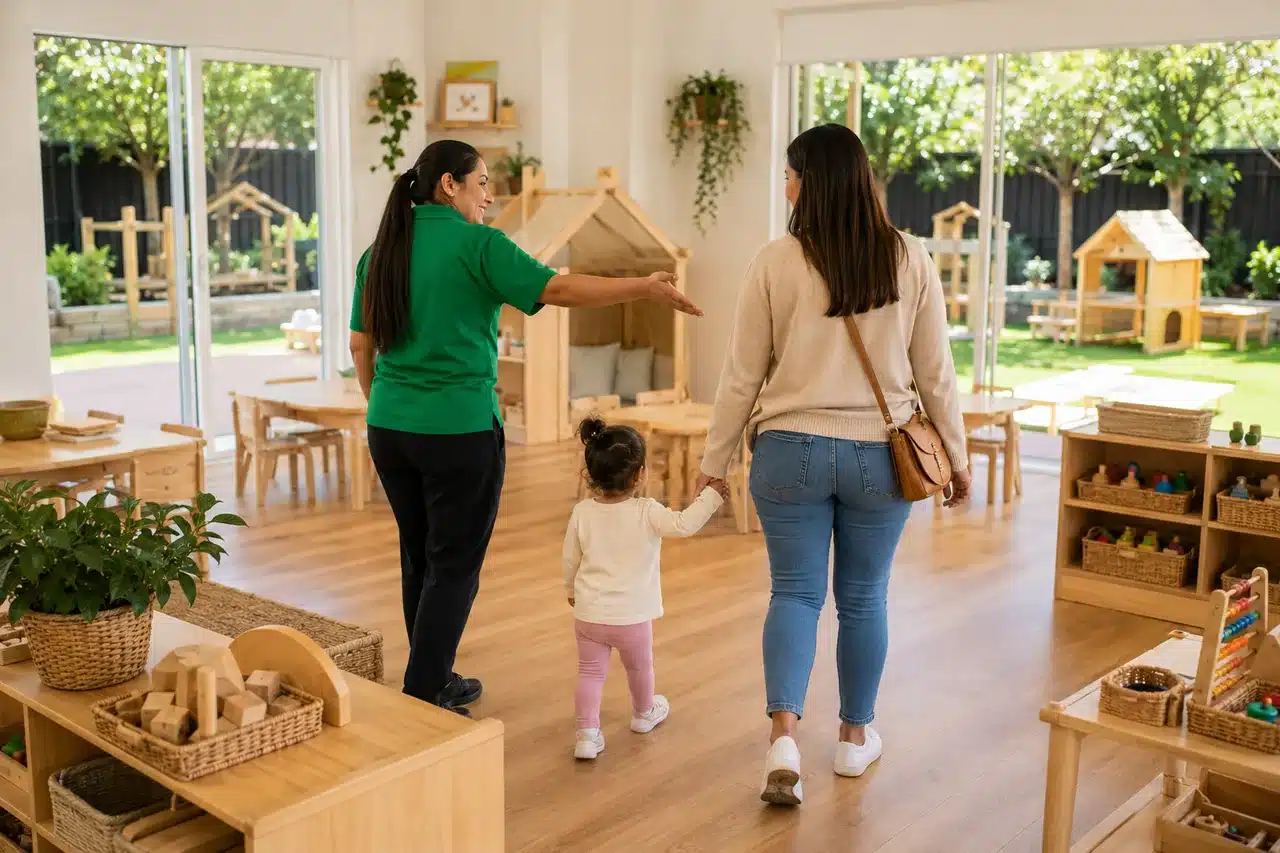
Visit in person. A centre tour is the best way to see the learning environment, meet the educators and observe how children are cared for throughout the day.
Ask about the educational program. Find out what curriculum framework the service uses, how educators plan for individual children and what the kindergarten program includes.
Understand the fees. Ask for a fee schedule and check your estimated CCS entitlement through Services Australia. Factor in any additional costs for meals, excursions or consumables.
Consider continuity. If your child will attend from babies through to kindergarten, a long day care centre offering integrated kinder avoids the need for a second enrolment elsewhere.
Check inclusion practices. Quality services welcome children from all backgrounds and abilities, creating inclusive environments that reflect the diverse communities they serve.
Australia offers a range of early childhood services to suit different family situations, from centre-based long day care for full working days to sessional kindergarten for focused early learning. Understanding the types available, how government funding works and what quality looks like helps you make an informed choice.
The most important step is visiting a service in person. A centre tour lets you see the learning environment, meet the educators and ask the questions that matter most to your family.
Book a tour at your nearest Happy Sprouts Early Learning centre to see how our programs support your child’s learning and development. Happy Sprouts provides centre-based long day care and funded kindergarten at Craigieburn, Beveridge and Greenvale, serving families across Melbourne’s northern suburbs with care and education from six weeks to six years.
The six main types are long day care, family day care, preschool/kindergarten, occasional care, outside school hours care and in-home care. All approved types are regulated under the National Quality Framework and assessed by ACECQA.
Most long day care centres accept children from approximately six weeks of age. Family day care and in-home care can also begin from birth. Outside school hours care is available for primary school-age children.
Kindergarten and preschool refer to the same educational stage: a structured learning program in the year or two before primary school. Victoria uses the term kindergarten, while other states may use preschool, pre-primary or pre-prep.
The CCS is a government payment that reduces childcare fees for eligible families. From January 2026, all eligible families receive at least 72 subsidised hours per fortnight (the 3 Day Guarantee). The subsidy percentage is based on family income, and the payment goes directly to the service to reduce your fees.
Educators in approved services hold Certificate III, Diploma or degree-level qualifications depending on their role. Four-year-old kindergarten programs must be delivered by a degree-qualified early childhood teacher. Requirements are set by the National Quality Framework and monitored by ACECQA.
Search for the service on Starting Blocks (startingblocks.gov.au), ACECQA’s free parent-facing website. You can view the service’s quality rating across seven areas, compare fees and check vacancies.
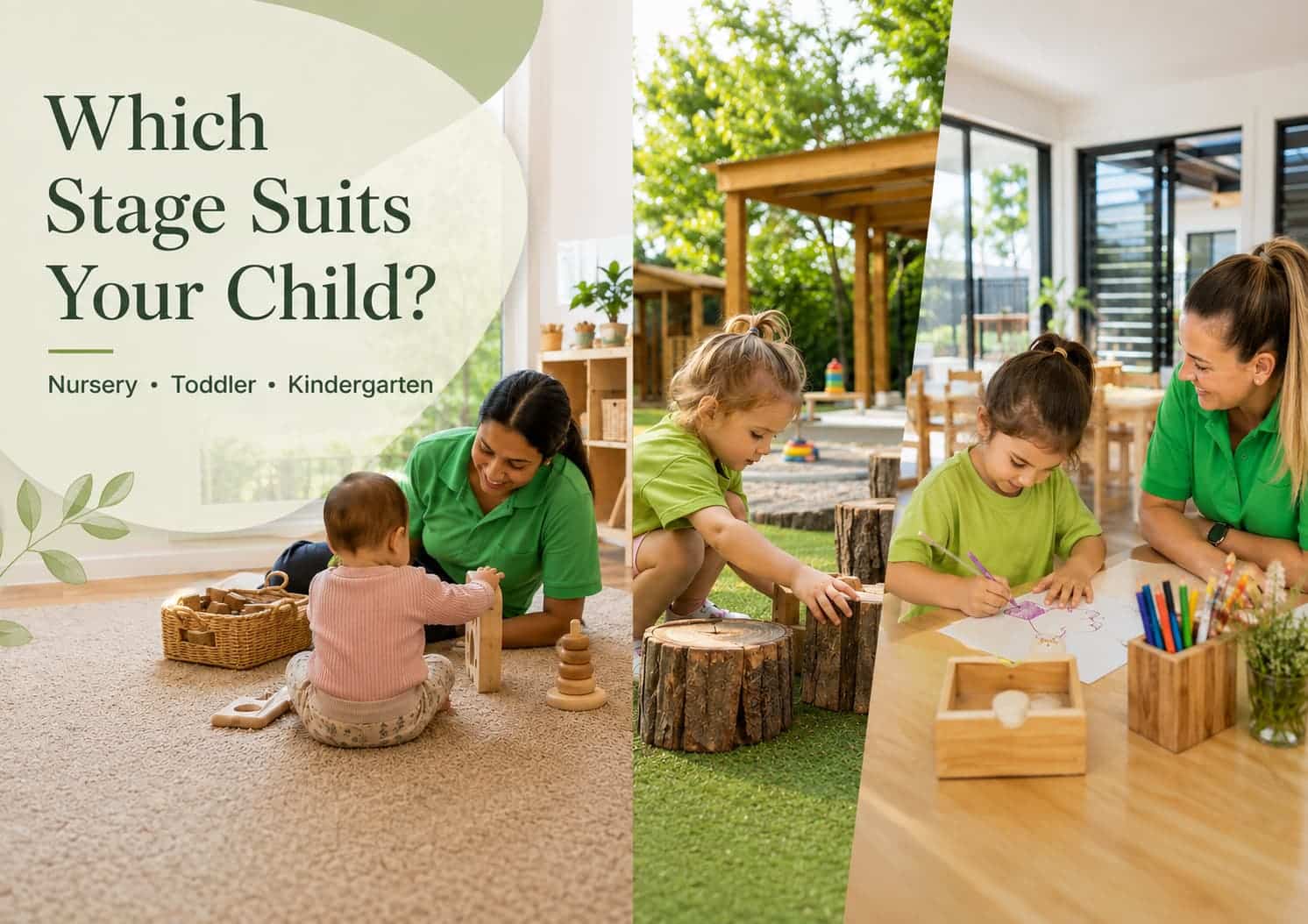
Nursery programs suit babies from approximately six weeks. Toddler programs suit children from aroun[...]
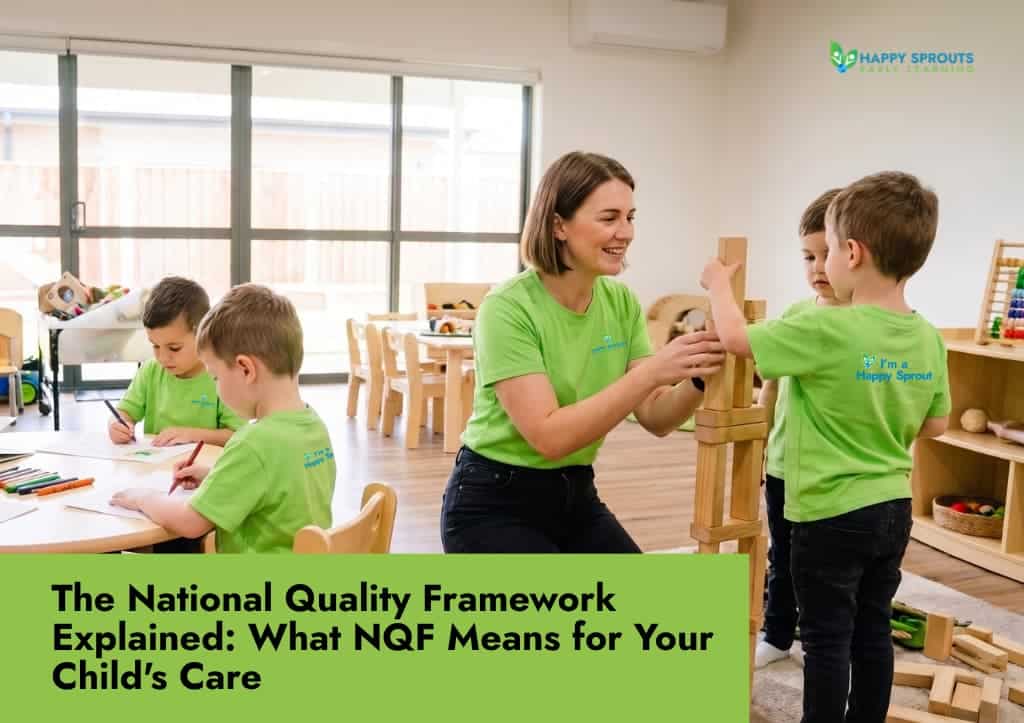
Quick answer The National Quality Framework (NQF) is Australia's national system for regulating a[...]
Childcare and kindergarten aren't the same thing. Childcare (or long day care) offers all-day [...]
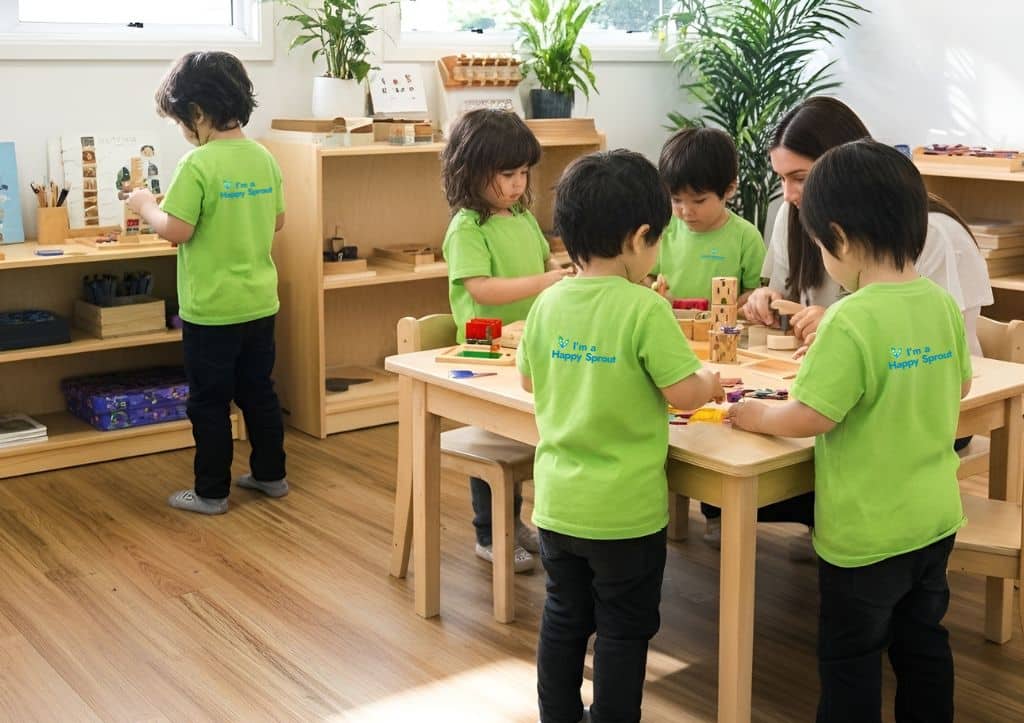
Play is not a break from learning in early childhood; play is the learning. Play-based learning in e[...]
Childcare in Victoria in 2026 is more affordable than ever for most working families, thanks to the [...]
A Simple Guide for Parents What Parents Should Know For each family, selecting daycare is a sign[...]