

Transition to school is the process of moving a child from kindergarten into the first year of primary school, called Prep or Foundation in Victoria. Getting a child ready for Prep means building social, emotional, independence, language and physical skills. The most effective strategies are steady routines, self-help practice, daily reading, school visits and sharing a Transition Learning and Development Statement (TLDS) with the school.
Key Takeaways
- School readiness is about the whole child, not only reading, writing or counting.
- Victorian children can start Prep if they turn five by 30 April of that year. School is compulsory from age six.
- Children do not need to read or write before Prep. Self-care, listening, getting along with others and coping with goodbyes matter more.
- The transition starts in the final year of kinder: enrol by the deadline, contribute to the TLDS and attend Term 4 orientation.
- Daily habits beat formal lessons: reading together, routines and practice with real school items build confidence.
- Your child’s kinder teacher is the best person to ask about readiness or delaying school entry.
The best strategies for getting a child ready for Prep are short, everyday habits rather than formal lessons. Play-based practice at home builds the skills children use most in the first term of school.
| Strategy | What to do | Skill it builds |
|---|---|---|
| 1. Read together daily | Share a book and ask what might happen next | Vocabulary, listening, early literacy |
| 2. Practise the school-day routine | Shift bedtime and wake-up times a few weeks before Term 1 | Lower anxiety, better energy |
| 3. Let your child do it | Give time to dress, pack the bag and put on shoes alone | Independence |
| 4. Use real school items | Practise with the actual lunchbox, drink bottle and bag | Fine motor skills, confidence |
| 5. Talk positively about school | Explain what will happen and answer questions honestly | Emotional readiness |
| 6. Visit the school | Attend orientation and walk past during the holidays | Familiarity, belonging |
| 7. Arrange play with classmates | Organise a playdate with a child starting at the same school | Friendships, social skills |
| 8. Build hand strength | Playdough, drawing, threading beads and child-safe scissors | Pencil grip, early writing |
Key relationships to remember:
Reading at home builds vocabulary and early literacy.
Consistent routines reduce anxiety about starting school.
Independence skills help children manage the school day on their own.
Parents model positive attitudes towards school.
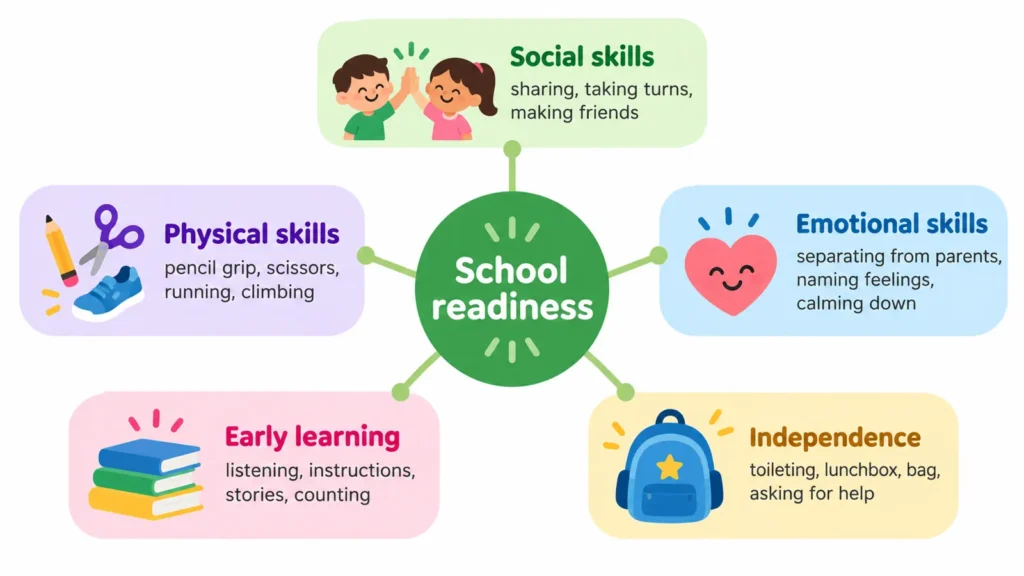
School readiness includes five connected skill areas: social, emotional, independence, language and early learning, and physical skills. Children do not need to read, write sentences or do sums before Prep, because Prep teachers teach these from the first day.
| Skill area | What it looks like before Prep |
|---|---|
| Social | Shares, takes turns, joins group play and makes friends |
| Emotional | Copes with goodbyes, names feelings and calms with support |
| Independence | Uses the toilet, opens a lunchbox, manages shoes and bag, asks for help |
| Language and early learning | Listens, follows two-step instructions, enjoys books, knows own name, counts objects |
| Physical | Holds a pencil, uses scissors, runs, climbs and balances |
These areas match what the Australian Early Development Census measures in a child’s first year of school: physical health and wellbeing, social competence, emotional maturity, language and cognitive skills, and communication skills and general knowledge.
The transition to school takes about 12 months and begins in the final year of kindergarten. Families enrol in Term 2, receive offers in August, and complete the TLDS and orientation in Term 4.
| When | What happens | Family action |
|---|---|---|
| Terms 1-2 (kinder year) | Child builds skills in four-year-old kinder | Talk with the kinder teacher about goals |
| Term 2 | Prep enrolment opens | Check your local school with Find my School, tour and apply |
| August | Schools send offers | Accept your offer by the deadline |
| Term 4 | TLDS shared; orientation sessions | Complete the TLDS family section; attend orientation |
| Summer holidays | Final preparation | Practise routines, uniform and lunchbox |
| Term 1 | Prep begins | Keep routines steady; stay in touch with the teacher |
| Step | Date |
|---|---|
| Applications open | Monday 20 April 2026 |
| Applications close | Friday 31 July 2026 |
| Outcomes sent | 3 – 14 August 2026 |
| Accept offer by | Friday 28 August 2026 |
Dates apply to Victorian government primary schools. Late applications are processed in the order received.
Every child can enrol at their local government school, based on their permanent address.
Catholic and independent schools set their own timelines.
For Prep 2028, expect applications to open in Term 2, 2027.
Source: Enrolling in Foundation (Prep), vic.gov.au, updated 26 March 2026.
A child can start Prep in Victoria if they turn five by 30 April of that school year. School is compulsory once a child turns six.
| Child’s date of birth | Earliest Prep year |
|---|---|
| 1 May 2021 – 30 April 2022 | 2027 |
| 1 May 2022 – 30 April 2023 | 2028 |
Delaying entry is a family decision with no single right answer.
Children born January to April are the youngest starters, so their families most often consider it.
Victorian guidance says kinder observations of development, literacy, numeracy and social-emotional readiness should inform the decision (Department of Education).
A second funded year of four-year-old kinder is only available when eligibility criteria are met.
Talk with your kinder teacher first, and your MCH nurse or GP where needed.
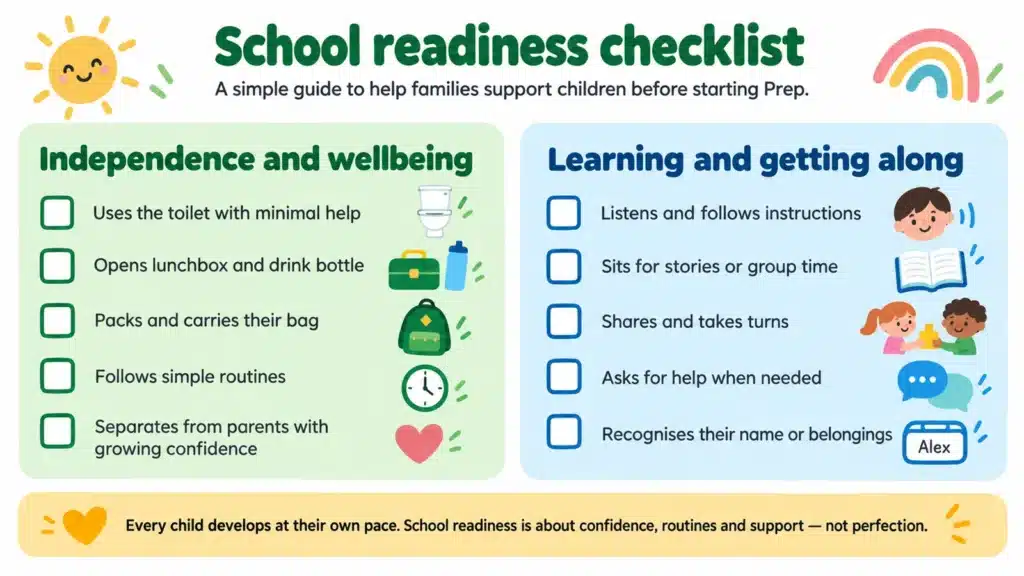
A child is likely ready for school when they can separate from a parent with support, manage basic self-care, follow simple instructions, play cooperatively and show interest in learning. No single skill decides readiness. Use this checklist as a guide, not a test.
Uses the toilet and washes hands with little help
Opens a lunchbox, drink bottle and food packets
Puts on shoes, a jumper and a hat
Says goodbye and settles with support
Tells an adult when they need help
Follows a two-step instruction
Takes turns and shares during play
Listens to a short story and talks about it
Holds a pencil or crayon to draw
Shows curiosity and asks questions
| Sign | Next step |
|---|---|
| Strong separation distress that does not ease over several weeks | Talk with the kinder teacher about settling strategies |
| Frequent daytime toileting accidents | Speak with your GP or MCH nurse |
| Difficulty joining group play or following group routines | Ask the kinder teacher for observations |
| Speech that unfamiliar adults find hard to understand | Ask your GP about a speech pathology assessment |
These signs do not mean a child cannot start school. They are a reason to get support early, while there is still time before Term 1.
Anxious children settle better when school feels familiar and predictable.
Read picture books about starting school
Visit the school playground on weekends
Keep goodbyes short, warm and the same each day
Tell the Prep teacher what helps your child feel calm
Children with additional needs benefit from starting transition planning early in the kinder year.
Ask the school for a transition meeting
Use the TLDS sections that support an enhanced transition
Share allied health reports and strategies with the school
Check eligibility for the NDIS early childhood approach (children under nine)
A Transition Learning and Development Statement (TLDS) is a written summary of a child’s strengths, interests and approaches to learning, prepared in the year before school. The TLDS helps the Prep teacher understand the child and plan their learning. It is not a report card.
| TLDS fact | Detail |
|---|---|
| Who completes it | The kinder teacher (Section 1), the child with adult help (Section 2) and the family (Section 3) |
| When | In the final year of funded kinder |
| Who receives it | The child’s school, unless the family opts out |
| Why it matters | Supports continuity of learning, as required by NQS Element 6.2.1 |
| Languages | Family guidelines are available in more than 40 languages |
In the family section, share: what your child enjoys, what helps them calm down, any worries about school, languages spoken at home, and health or support needs.
Source: TLDS, vic.gov.au, updated 24 August 2026; Transition to school resources for families.
Four-year-old kindergarten prepares children for Prep by building social, emotional, language and thinking skills through play. Children practise group routines, listening, problem-solving and independence at a pace suited to their age. Play-based learning develops problem-solving, self-regulation and confidence (why play-based learning matters).
Victoria funds 15 hours per week of four-year-old kinder. Extra hours are being added in stages by local council areas through Pre-Prep.
| Happy Sprouts program | How it supports the transition to school |
|---|---|
| Four-year-old kinder led by a degree-qualified early childhood teacher | Individualised program building skills and dispositions for school |
| Library program with weekly borrowing and personal library bags | Encourages reading at home and vocabulary |
| Premier’s Reading Challenge and Hume Library visits | Builds early literacy and community connection |
| STEM room and smartboard activities | Encourages curiosity and problem solving |
| Garden to Plate | Builds responsibility and fine motor skills |
| Observe, Question, Plan, Act, Reflect cycle | Shapes learning around each child’s interests and progress |
| Parent app with learning stories | Keeps families informed about progress |
| Links with local primary schools | Educators work with parents and local school teachers; may include school tours and orientation |
Happy Sprouts offers a funded sessional kinder program at Craigieburn and Greenvale, with two-day and three-day options. Our curriculum is guided by the VEYLDF and the EYLF.
Many children feel tired in the first weeks of Prep because the school day is longer and busier than kinder. Big feelings after school are common and usually ease as routines settle.
Complete the SEHQ: school nurses use the School Entrant Health Questionnaire to understand each Prep child’s health.
Book OSHC early: before and after school care places can fill quickly.
Label everything: bag, hat, jumper, lunchbox and drink bottle.
Plan pick-up: tell your child who will collect them and where.
Keep afternoons calm: protect sleep and downtime.
Ask for help early: speak with the teacher when your child does not seem to be settling.
The transition to school works best as a gradual process that starts in the final year of kinder. Build independence and emotional readiness through daily habits, enrol on time, contribute to the TLDS and attend orientation. Your child’s kinder teacher is your key partner throughout.
See how our kinder program builds confidence, independence and a love of learning before Prep. Book a tour at Happy Sprouts Early Learning in Craigieburn, Greenvale or Beveridge.
No. Writing their name is not required for Prep. Recognising their name and trying some letters helps, but Prep teachers teach letter formation from the start of the year.
Most Victorian schools run Prep orientation in Term 4 of the year before school. Each school sets its own dates, so check with your school after accepting an offer.
No. Kindergarten is not compulsory, but four-year-old kinder builds the skills that support the transition to school. Learn more about kinder and childcare costs in Victoria.
Settling time varies from child to child. Speak with the Prep teacher when your child still seems unsettled after the first few weeks.
Early childhood services are the regulated education and care options available for children from bi[...]
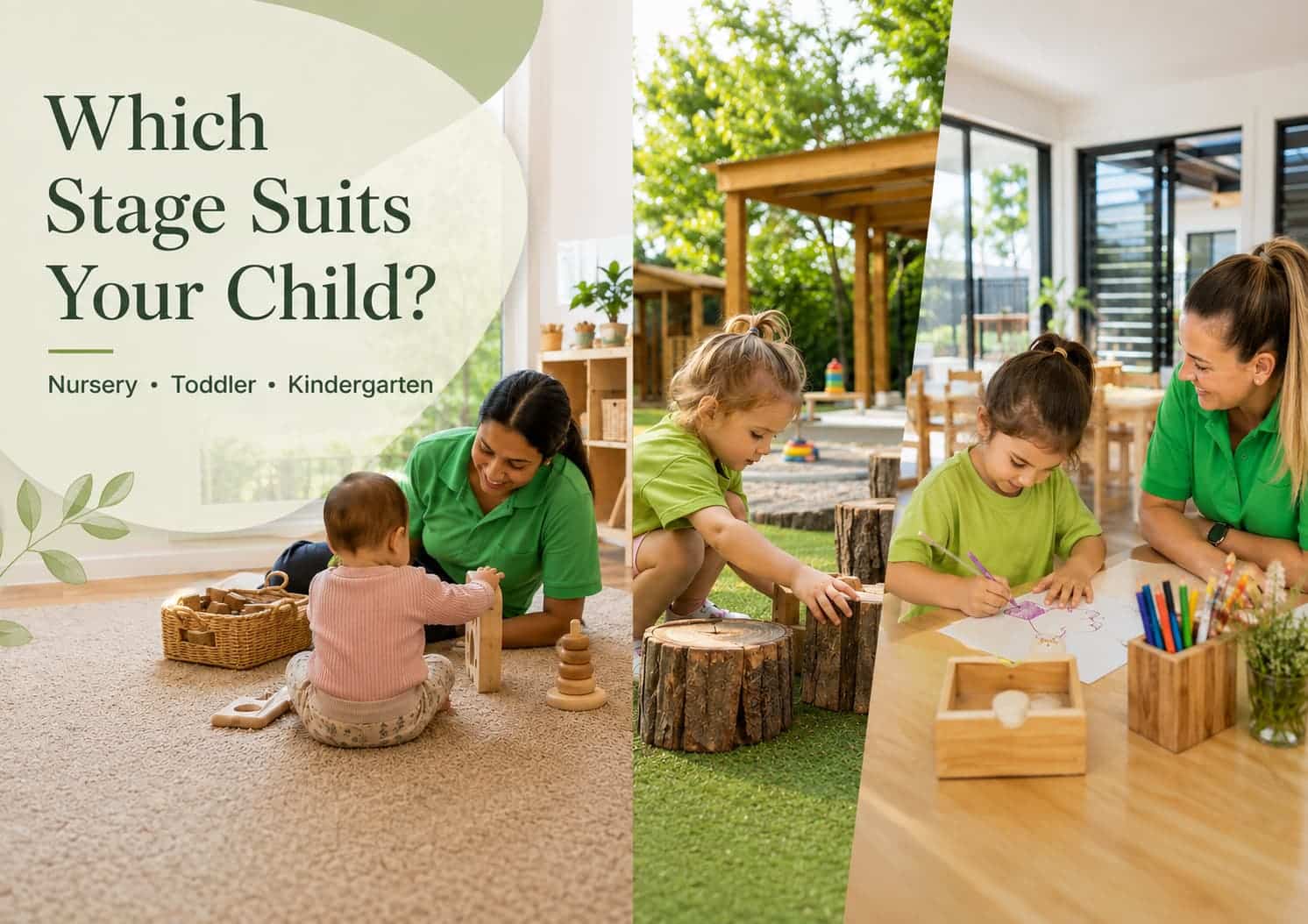
Nursery programs suit babies from approximately six weeks. Toddler programs suit children from aroun[...]
Quick answer The National Quality Framework (NQF) is Australia's national system for regulating a[...]
Childcare and kindergarten aren't the same thing. Childcare (or long day care) offers all-day [...]
Play is not a break from learning in early childhood; play is the learning. Play-based learning in e[...]
Childcare in Victoria in 2026 is more affordable than ever for most working families, thanks to the [...]