



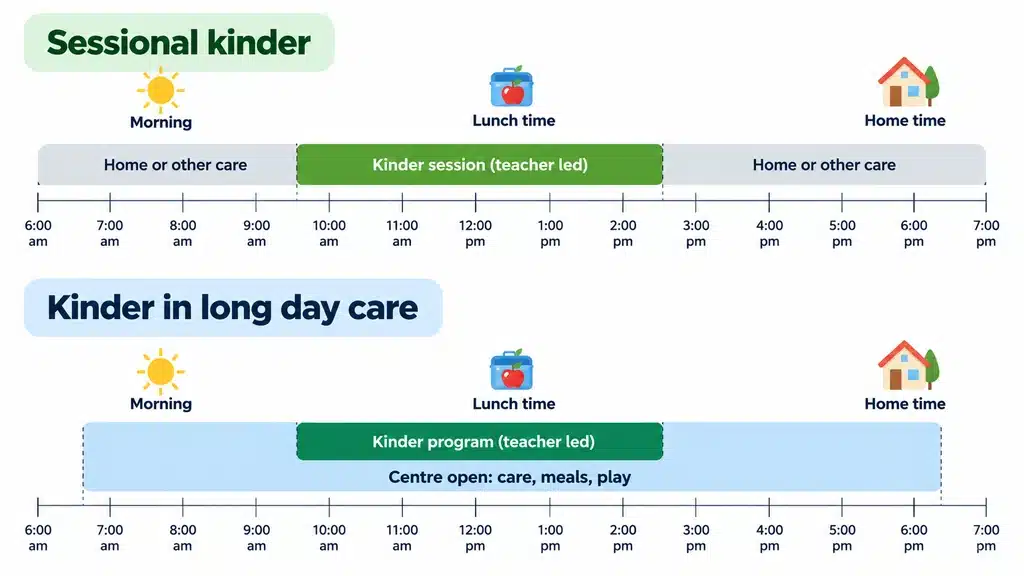
Sessional kinder is a free, teacher-led kindergarten program for three- and four-year-old in Victoria that runs only during set session hours, usually for up to 15 funded hours a week over 40 weeks of school terms. It is also called standalone kinder. The same funded program is offered inside long day care centres as integrated kinder, where it sits within a longer day of care. In short: sessional kinder suits families who need shorter days, while integrated kinder suits families who need full working days and holiday care.
- Definition: sessional kinder is a standalone, teacher-led kinder program that runs only in session hours and often closes in school holidays.
- Same program, two settings: sessional kinder and integrated kinder in long day care follow the same government guidelines and are both led by a qualified teacher.
- Cost: Free Kinder makes participating in sessional programs free. In long day care, it applies as an annual fee offset after the Child Care Subsidy.
- Hours: 3-year-old kinder offers 5 to 15 funded hours a week. 4-year-old kinder offers 15, and Pre-Prep is adding more hours area by area.
- Enrolment: In Hume, sessional kinder places are registered through Council. Integrated kinder is booked directly with the long day care centre.
Sessional kinder is a funded kindergarten program run by a standalone service that operates only during kinder session hours, with no care before or after. The Victorian Government describes these standalone services as setting their own days and hours and often closing during school holidays.
Your child attends set sessions each week, for example two or three days, then goes home or to other care.
Every funded kinder program in Victoria is planned and delivered by a qualified early childhood teacher. Programs are play-based and follow the Victorian Early Years Learning and Development Framework (VEYLDF) and the National Quality Framework. A typical session mixes group time, stories and songs, indoor and outdoor play, and planned experiences that build early literacy, numeracy, friendships and independence.
Yes. Kinder, kindergarten and preschool all describe the same funded early learning program in the two years before school. Victoria calls it kinder, while some other states call it preschool. “Sessional” only describes how the program is delivered: in sessions, without long day care around it.
In the Victorian Government’s words, kinder is “a program, not a place” (Kinder Tick). The same funded program can run in a standalone kindergarten or inside a long day care centre. Prep is different again. It is the first year of primary school, not kinder.
In most areas, sessional kinder runs for up to 15 funded hours a week over 40 weeks. Three-Year-Old Kinder (3-year-old kinder) offers 5 to 15 hours a week, rising to 15 everywhere by 2029, and Four-Year-Old Kinder (4-year-old kinder) offers 15 hours a week (Free Kinder). The 40 weeks follow Victorian school terms.
Each service decides how those hours are split. One kinder might run two longer days, while another runs three shorter ones. Ask for the session timetable before you register so you can plan work and pick-ups.
| Program | Funded hours per week | What changes next |
|---|---|---|
| Three-Year-Old Kinder | 5 to 15 | 15 hours statewide by 2029 |
| Four-Year-Old Kinder | 15 | Becoming Pre-Prep, area by area |
| Pre-Prep, Mitchell Shire (includes Beveridge) | 16 to 20 from 2026 | Up to 25 from 2029, up to 30 from 2031 |
| Pre-Prep, Hume City (includes Craigieburn and Greenvale) | 16 to 20 from 2034 | Up to 25 in 2035, up to 30 from 2036 |
| Pre-Prep, priority groups statewide | 16 to 25 from 2026 | Up to 30 from 2028 |
Pre-Prep is Four-Year-Old Kinder with more hours, growing from 15 towards 30 a week under the Victorian Government’s Best Start, Best Life reforms. Other than the extra hours, the program is the same. It will be offered in both sessional kinders and long day care centres.
Priority groups can already access more hours wherever they live. These include Aboriginal and Torres Strait Islander children, children from a refugee or asylum seeker background, children who have had contact with Child Protection, and children supported by Early Start Kindergarten or Access to Early Learning in their three-year-old year.
Important to know: Many websites still say Pre-Prep reaches metropolitan Melbourne in 2030. The Victorian Government schedule updated in August 2026 lists metropolitan councils, including Hume City, from 2034. Use the Pre-Prep calculator to check your child’s year.
Sessional kinder and integrated kinder deliver the same funded, teacher-led program. The differences are the length of the day, holiday care, and how you pay and enrol.
| Feature | Sessional (standalone) kinder | Kinder in long day care |
|---|---|---|
| Teacher and program | Qualified teacher, play-based, government guidelines | Same |
| Hours | Only the kinder session | Kinder session inside a longer day of care |
| School holidays | Often closed | Care usually continues; check with the centre |
| Cost with Free Kinder | No compulsory out-of-pocket fees at participating services | Annual Free Kinder offset, applied after CCS |
| Younger siblings | Need separate care | Can often be cared for at the same centre |
| Enrolling in Hume | Through Hume City Council central registration | Directly with the centre |
Which setting suits your family?
- Sessional kinder may suit you if a parent or carer is home or works flexible hours, your child does well with shorter days, or a sessional kinder is close to home.
- Kinder in long day care may suit you if you work full days, need care in school holidays, or want younger children cared for at the same place.
- Either can work if you mainly want a quality, teacher-led year before school. Visit both types near you and compare how the day feels.
For a broader look at the two services, read our guide to the difference between childcare and kindergarten.
Yes. Sessional kinder is free at services that take part in Free Kinder, with no compulsory out-of-pocket fees for the funded program (Free Kinder). A service may still charge for one-off excursions or incursions, or a registration fee that is refunded once you accept a place.
Free Kinder is for everyone. You do not need a Health Care Card, Australian citizenship, proof of address or eligibility for the Child Care Subsidy (CCS).
In long day care, Free Kinder becomes an annual fee offset that the centre spreads across your invoices. The Victorian Government lists these savings:
- Three-year-olds: $700.33 a year (5 hours) up to $2,101 (15 hours)
- Four-year-olds: $2,101 a year (15 hours)
- Four-year-olds in Pre-Prep: $2,241 (16 hours) up to $4,202 (30 hours)
CCS is applied first, then the Free Kinder offset. In the government’s own example, a family charged $360 a week for three days receives $252 in CCS and a $52.53 weekly offset, leaving about $55 to pay. Your figures will differ, so use our Child Care Subsidy guide and calculator and ask the centre for a written estimate.
Common mistake: Free Kinder can only be claimed at one service at a time. If your child attends sessional kinder on some days and long day care on others, you sign a form naming the one service that receives it. Hours above the funded hours may also cost extra.
In Victoria, children start Three-Year-Old Kinder in the year they turn three, as long as they turn three by 30 April. Families of children born between January and April can choose to start in the year the child turns three or the year they turn four (When to start kindergarten).
Quick answer, using 2027 as the example:
- Born January to April 2024: can start Three-Year-Old Kinder in 2027 or 2028.
- Born May to December 2024: start Three-Year-Old Kinder in 2028.
Some children benefit from a second year of Four-Year-Old Kinder because of a developmental delay. This is decided with the kinder teacher. The government’s starting age calculator on the same page confirms your child’s years.
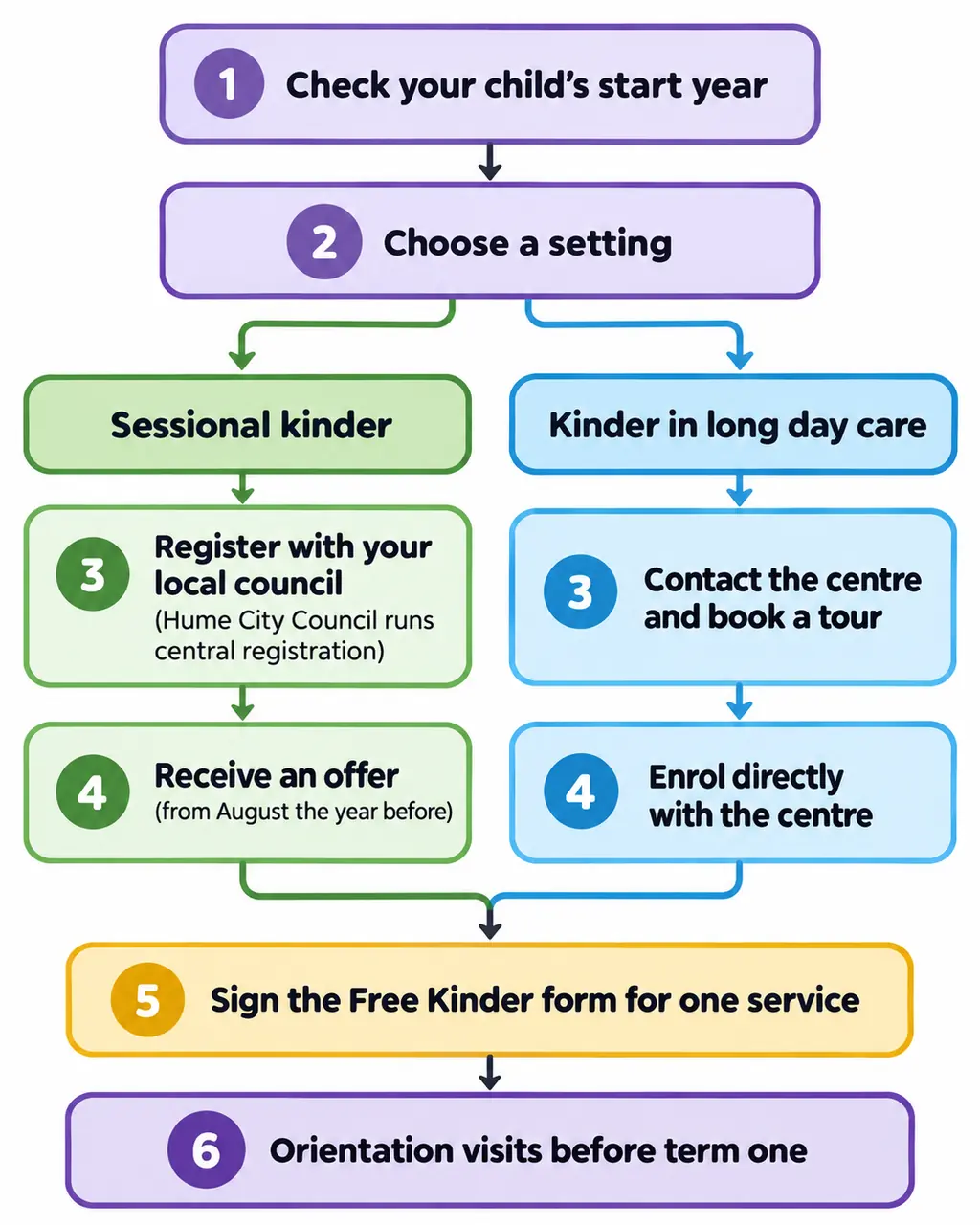
Enrol in sessional kinder through your council’s central registration where one runs, and enrol in integrated kinder directly with the long day care centre. In Hume, which covers Craigieburn and Greenvale, Council runs central registration for sessional kinder at both Council and non-Council services (Hume City Council).
Hume opens registrations well ahead. Registrations for 2028 opened on 1 March 2026, and offers are made from August in the year before kinder starts. Families in Beveridge, which is in Mitchell Shire, should ask Mitchell Shire Council whether a central registration process applies.
Quick enrolment checklist
- Check which year your child can start, using the starting age calculator.
- Decide whether sessional kinder or kinder in long day care fits your work and care needs.
- Visit services and ask for their session days and times.
- For sessional kinder in Hume, register through Council and list your preferred kinders.
- For kinder in long day care, enrol directly with the centre and book a tour.
- When you accept a place, sign the Free Kinder form naming that service.
- Book orientation visits so your child can meet the teacher before term one.
A quality kinder program carries the Kinder Tick and holds a good National Quality Standard rating. The Kinder Tick shows the program is led by a qualified teacher, uses play-based learning, is funded and approved by the Victorian Government, and follows government guidelines and the National Quality Framework (Kinder Tick). It is not a quality rating. For that, check the service’s National Quality Standard rating on StartingBlocks, and search programs near you with Find a kinder program.
Practical tip: take these questions to every visit.
- Which days and times are the kinder sessions?
- Who is the kinder teacher, and how long have the group’s educators been at the service?
- Are meals included, and what do we need to pack?
- Is care available in school holidays?
- Are there any extra fees beyond the funded program?
- How do you share learning updates and support the move to school?
Good kinder programs look beyond letters and numbers. They build confidence, independence, friendships and the routines children need for Prep, which is the focus of our school readiness program.
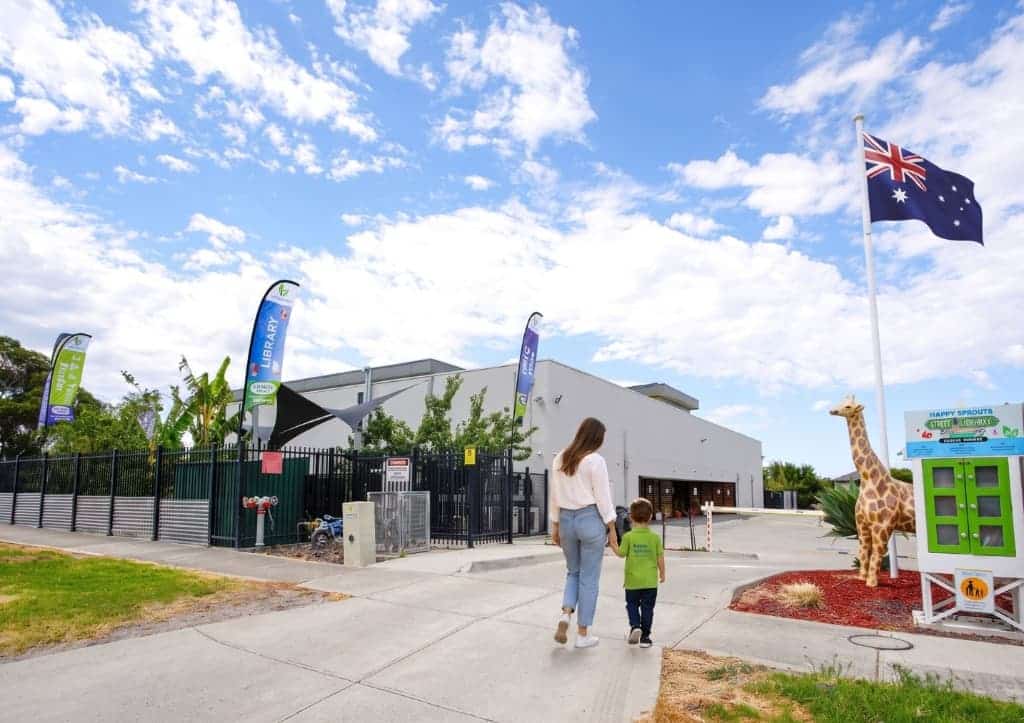
Happy Sprouts Early Learning offers a Victorian Government-approved, funded kinder program for 3 to 4-year-old at its Craigieburn and Greenvale centres. It is part of the Best Start, Best Life reforms and is delivered by a qualified kinder teacher in a session format.
Families choose one of two attendance patterns:
- Two days a week, 8:30 am to 4:30 pm (advertised as 7.5-hour sessions)
- Three days a week, 9:30 am to 2:30 pm (5-hour sessions)
Happy Sprouts states there are no out-of-pocket costs for CCS-approved families. Meals, hygiene essentials and learning resources are provided, so families pack a labelled water bottle and a change of clothes. Children also use dedicated STEM and library rooms, take part in weekly music and sports incursions, join the Premier’s Reading Challenge and visit Hume Library. Every enrolled child receives a kinder pack with a shirt, kinder bag and library bag (terms and conditions apply).
See the full details of our funded kinder program at Craigieburn and Greenvale, or check the session times and what’s included. Places are limited, and eligibility should be confirmed with the centre.
Sessional kinder is a free, teacher-led kindergarten program that runs in set sessions, usually during school terms. It gives three- and four-year-old the same funded program offered as integrated kinder in long day care, without the extra hours of care. The right choice comes down to your working hours, holiday care needs and the services near you.
Check your child’s start year, compare the settings, and register early, because Hume opens registrations well over a year ahead. If you live near Craigieburn or Greenvale and want a funded kinder program with meals and resources included, book a tour to see the kinder rooms and meet the teacher.
In practice, yes. Victoria uses “kinder” for the funded program in the two years before school, and other states often call it preschool. “Sessional” means the program runs in set sessions without long day care around it.
Yes. Many children attend sessional kinder on some days and long day care on others. Free Kinder can only be claimed at one service, so you sign a form naming the service that receives it.
Standalone kinders are often closed in school holidays because the program runs for 40 weeks a year. If you need holiday care, kinder in long day care is usually the more practical option.
No. Free Kinder is for all Victorian families at participating services. In long day care, CCS is applied first if you are eligible, then the Free Kinder offset reduces what is left.
Each service sets its own pattern within the funded hours. Common patterns are two longer days or three shorter days a week. Ask for the timetable before you register.
Under the schedule updated in August 2026, Hume City joins Pre-Prep from 2034 with 16 to 20 hours a week. Children in priority groups can already access 16 to 25 hours. Check your child with the Pre-Prep calculator.
It depends on the service. At Happy Sprouts’ funded kinder program, families pack a labelled water bottle and season-appropriate spare clothes, and meals, hygiene items and learning resources are provided.
Playgroup benefits for toddlers include stronger social skills, early language, emotional confidence[...]
Transition to school is the process of moving a child from kindergarten into the first year of prima[...]
Early childhood services are the regulated education and care options available for children from bi[...]
Nursery programs suit babies from approximately six weeks. Toddler programs suit children from aroun[...]
Quick answer The National Quality Framework (NQF) is Australia's national system for regulating a[...]
Childcare and kindergarten aren't the same thing. Childcare (or long day care) offers all-day [...]


