


A daycare nursery room is the room in a long day care centre that provides daycare for babies, usually from six weeks to two years old. Each baby follows their own routine for feeds, sleep and nappy changes, cared for by qualified educators at a minimum ratio of one educator to four babies under the National Quality Framework.
Babies sleep on their backs in cots with recorded bedside checks, bottles are given on cue, and play focuses on movement, senses and early communication.
The bottom line: starting daycare with a baby goes best with at least two orientation visits, a detailed handover of your baby’s routine and a gradual first few weeks.
- Definition: a nursery room (also called a baby’s room or infant room) is the daycare room for babies from about six weeks to two years old, run around each baby’s own routine rather than a group timetable.
- Ratios: the national minimum is one educator to four children under 24 months.
- Sleep: babies sleep on their backs in cots that meet the Australian standard, and educators check and record sleeping children at the bedside.
- Feeding: centres store labelled expressed breastmilk and give bottles on cue, so clear labels and small portions matter.
- Settling: babies under about six months often settle easily, while fear of strangers usually peaks between seven and ten months.
A nursery room is the room in a long day care centre that provides infant childcare for babies from about six weeks to two years old.
Centres also call it the babies’ room or infant room. Some split it in two: a babies’ room for children under one, and a walkers’ room for children who are crawling, standing or taking their first steps.
Nursery room at a glance
| Feature | What to expect |
|---|---|
| Age range | About 6 weeks to 24 months |
| Minimum ratio | 1 educator to 4 children (birth to 24 months, all states) |
| Daily routine | Individual: feeds, sleeps and nappy changes follow each baby’s cues |
| Sleep | On the back, in cots meeting AS/NZS 2172, with recorded bedside checks |
| Feeding | Labelled expressed breastmilk or formula given on cue; solids when ready |
| Learning | Play-based, guided by the Victorian Early Years Learning and Development Framework |
| Before starting | Orientation visits and an Immunisation History Statement (No Jab No Play) |
Unlike a kinder room, the nursery has no fixed lesson times. Educators follow each baby’s cues for hunger, tiredness and play, and they keep a record of feeds, sleeps and nappy changes that is shared with families.
Babies are cared for by qualified early childhood educators. Under the National Quality Framework, the minimum ratio for children from birth to 24 months is one educator to four children in every state and territory, including Victoria (ACECQA educator to child ratios).
Important to know: One educator to four babies is a minimum, not a target. Ratios are also calculated across the whole service, so ask the centre how the nursery room itself is staffed at drop-off, lunchtime and late afternoon.
Babies in a nursery room follow their own routine of feeds, sleeps, nappy changes and play, rather than a group timetable.
Each baby moves through their own rhythm of feeds, sleeps, nappy changes and play, and educators record each one. The table shows what usually happens across a day and what you can share to help.
| Part of the day | What usually happens | What you can share |
|---|---|---|
| Drop-off handover | An educator greets you and your baby and notes anything important for the day | Last feed and sleep times, how the night went, any teething or illness |
| Feeds | Bottles are given when your baby shows hunger cues; older babies join meal times once they eat solids | Usual feed times, amounts and cues, and which foods your baby already eats |
| Sleep | Babies sleep in a cot in a dedicated sleep area when they show tired signs, with regular bedside checks | How your baby shows tiredness and settles, and their usual nap length |
| Nappy changes | Nappies are checked regularly and changed as needed, and each change is recorded | Any creams, skin sensitivities or toileting notes |
| Play and learning | Floor play, tummy time, sensory play, songs, books and time outdoors | Favourite songs, toys or games from home |
| Pick-up handover | Educators tell you how the day went, often backed by a written or app report | Anything to watch overnight or change tomorrow |
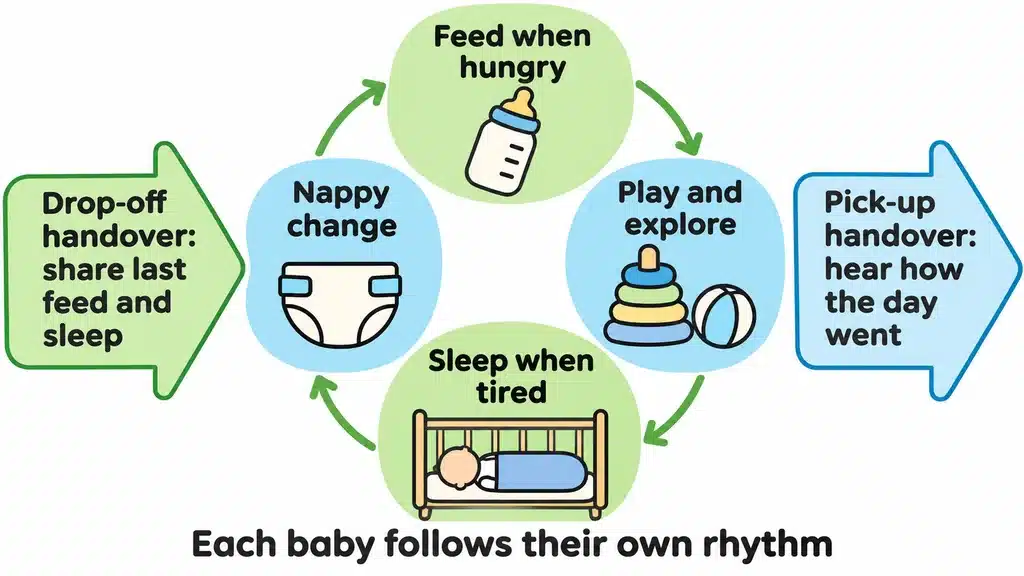
Babies learn through relationships and everyday moments. Victorian services plan for children from birth using the Victorian Early Years Learning and Development Framework, so a nappy change becomes a chance to talk and sing, and floor play builds the strength needed for rolling, sitting and crawling. Sensory play, picture books and outdoor time give babies new things to look at, touch and hear.
Babies sleep on their backs in cots that meet the Australian standard, and educators check them at the bedside and record every check.
Babies sleep in cots in a safe sleep area, placed on their backs, and educators check them at the bedside and record every check. National guidelines updated in March 2026 require each service to complete a sleep and rest risk assessment and to follow Red Nose Australia’s safe sleep advice (ACECQA sleep and rest guidelines).
In practice, that means:
- Cots that meet the Australian mandatory standard AS/NZS 2172. Bassinets must not be on the premises while children are in care.
- Babies placed on their backs to sleep, with head and face uncovered (Red Nose safe sleep advice).
- Regular physical checks of breathing, skin and lip colour, body temperature and head position, recorded when they happen.
- No bibs, jewellery or loose clothing in the cot, and no bumpers, positioners or extra padding for children under two.
If you ask for something that goes against safe sleep advice, such as tummy sleeping, the centre cannot agree to it without written authorisation from your baby’s doctor. Red Nose also advises that soft toys and comforters should not go in a cot until at least seven months of age, and each centre decides on comforters through its own risk assessment.
Practical tip: In the weeks before starting, let your baby have some naps in a cot rather than only in arms, a pram or the car. Tell educators exactly how your baby settles, such as patting, a song or a sleeping bag, so they can copy it where it is safe to do so.
Educators give bottles on cue using the feeding plan agreed at enrolment, and expressed breastmilk must be labelled, refrigerated and warmed safely.
Educators give bottles when your baby shows hunger cues and follow the feeding plan you agree at enrolment. If you supply expressed breastmilk, Victoria’s Healthy Eating Advisory Service sets out how it should be handled (Practical management of expressed breastmilk):
- Each bottle or bag labelled with your baby’s full name, the date and time it was expressed, and whether it is fresh or thawed.
- Fresh milk stored at the back of the fridge at 5°C or lower and used within 72 hours.
- Milk warmed in warm water for up to 15 minutes, never in a microwave, and warmed only once.
- Any milk left after a feed should be thrown away, and thawed milk should never be refrozen.
If your baby is breastfed, tell the centre at enrolment and ask about paced bottle feeding, which lets breastfed babies control how much they drink (Australian Breastfeeding Association). If you use formula, ask whether you supply it and how the centre wants it measured, labelled and sent in. For babies on solids, share which foods your baby has already tried and any allergies or reactions.
Common mistake: Sending one large bottle of breastmilk for the whole day. Warmed milk that is not finished must be thrown away, so small labelled portions waste far less.
Babies settle best with orientation visits, shorter first days and a consistent goodbye routine. Settling usually takes days to weeks.
Most babies settle with time, especially when they visit beforehand, start with shorter days and get to know one or two educators. Raising Children Network notes that babies under six months often settle easily because fear of strangers and separation anxiety have not developed yet (Raising Children Network).
There is no single best age to start daycare. Babies under about six months often settle more easily, while babies of seven to ten months may need more orientation visits because fear of strangers is at its peak. The right time depends on your return to work and your baby’s feeding and sleep.
| Age at start | What is typical | What helps most |
|---|---|---|
| Under 6 months | Fear of strangers has usually not started, so many babies settle quickly | Detailed notes on feeds, sleep and soothing so educators can match home |
| About 7 to 10 months | Fear of strangers usually peaks, so new faces can upset your baby | Several orientation visits, a familiar educator and a calm, short goodbye |
| About 14 to 18 months | Separation anxiety usually peaks, often with tears at drop-off | A consistent goodbye routine and telling your child when you will be back |
Source: Raising Children Network. Every child is different, and settling can take days or weeks.
Quick settling checklist
- Book orientation visits and stay with your baby for the first one.
- Start with shorter days, then build up to full days.
- Share your baby’s routines, soothing methods and any changes at home.
- Always say goodbye, keep it brief and positive, and tell the educator when you are leaving.
- Call the centre during the day if you want an update. Most centres welcome it (Raising Children Network).
In Victoria, No Jab No Play rules mean you must give the centre an Immunisation History Statement from the Australian Immunisation Register showing your baby is up to date for their age before enrolment is confirmed. Some families, such as healthcare card holders or families receiving child protection support, can use a 16-week support period while they catch up (Victorian Department of Health). It also helps to check your Child Care Subsidy before you start, using our Child Care Subsidy guide and calculator.
Pack labelled bottles, nappy supplies if not provided, spare clothes, a sleeping bag and a sun hat, and confirm the list with your centre.
Pack for a full day of changes, feeds and sleep, then check the list with your centre, because what is supplied differs between services. Label everything with your baby’s name.
- Bottles of expressed breastmilk or formula, as agreed with the centre, in small labelled portions.
- Nappies, wipes and any barrier cream, unless the centre supplies them.
- Two or three full changes of clothes, plus extra singlets and socks.
- A sleeping bag that suits the season, if the centre uses them.
- A comforter or dummy only if the centre’s sleep policy allows it.
- A sun hat for outdoor time.
- Any medication, handed to an educator with the signed authority form.
Educators record feeds, sleeps and nappy changes and share them at pick-up or through an app.
Most nursery rooms record feeds, sleeps and nappy changes through the day and share them with families, often through an app with photos. Use drop-off and pick-up to swap information in person, and tell educators about anything that changes at home, such as a new tooth, a new food or a bad night.
Babies get sick more often in their first months of care. Victoria sets minimum exclusion periods: for example, children with gastro stay home until 24 hours after the last vomit or loose bowel motion, and children with hand, foot and mouth disease stay home until all blisters have dried (School exclusion table). Plan back-up care for these days before you return to work.
Happy Sprouts Early Learning cares for babies from six weeks old in its nursery program for children up to two years, at its Craigieburn, Beveridge and Greenvale centres. The program focuses on nurturing relationships, emotional security, sensory exploration, early communication and physical development.
At the Craigieburn centre, the nursery and walkers rooms include:
- Kangaroo Paws, a babies room for six weeks to 12 months, with its own outdoor area of grass and cushioned pavement.
- Lilly Pillies, a walkers room next door, with outdoor areas that include a sandpit and veggie patch.
- A separate kitchen area for preparing formula and storing milk.
- Spaces designed to stimulate the five senses, with specialist educators who stay close to each child.
How starting works at Happy Sprouts
Before your baby starts, an educator talks with you about your family, your baby’s medical history and their dietary, rest and sleep needs, and you build an individualised orientation plan together. Happy Sprouts recommends at least two orientation sessions (getting started at Happy Sprouts). Once your baby is enrolled, the free Happy Sprouts app shares bottle intake, food intake, nappy changes, sleep times and sun protection, along with photos and messages from the room.
Happy Sprouts states that it keeps higher staff-to-child ratios than industry standards require, and its educators hold First Aid, CPR and anaphylaxis management certifications. For more on how the nursery fits with later stages, read our guide to nursery, toddler and kindergarten programs.
In summary: a nursery room gives babies one-on-one style care inside a group setting. Each baby keeps their own routine for feeds, sleep and nappy changes, with qualified educators at a minimum ratio of one to four, safe sleep checks and play that builds early skills.
The best start comes from preparation: share your baby’s routines in detail, attend orientation visits, label small portions of milk and plan for the first few weeks to be gradual. If you are in Melbourne’s north, book a tour of a Happy Sprouts nursery room to see the space and meet the educators.
There is no single best age. Many Victorian centres, including Happy Sprouts, take babies from six weeks. Babies under six months often settle more easily, while those starting around seven to ten months may need more orientation visits.
The national minimum ratio for children from birth to 24 months is one educator to four children. Some centres staff above this minimum, so ask how the nursery room is staffed through the day.
No, not without written authorisation from your baby’s doctor. Centres must follow safe sleep guidance, which means placing babies on their backs to sleep.
It depends on the centre. Some supply nappies, wipes or formula and others ask families to bring them, so check what is included before your first day.
It varies from a few days to several weeks. Shorter first days, orientation visits and a consistent goodbye routine usually help, and babies under six months often settle more easily.
Educators will contact you to collect your baby. Victorian exclusion rules then set how long your baby stays home, such as 24 hours after the last vomit or loose bowel motion for gastro.
Educators record feeds, sleeps and nappy changes and share them at pick-up, often through an app. At Happy Sprouts, the parent app shows bottle intake, sleep times, nappy changes and photos.
Sessional kinder is a free, teacher-led kindergarten program for three- and four-year-old in Victori[...]
Playgroup benefits for toddlers include stronger social skills, early language, emotional confidence[...]
Transition to school is the process of moving a child from kindergarten into the first year of prima[...]
Early childhood services are the regulated education and care options available for children from bi[...]
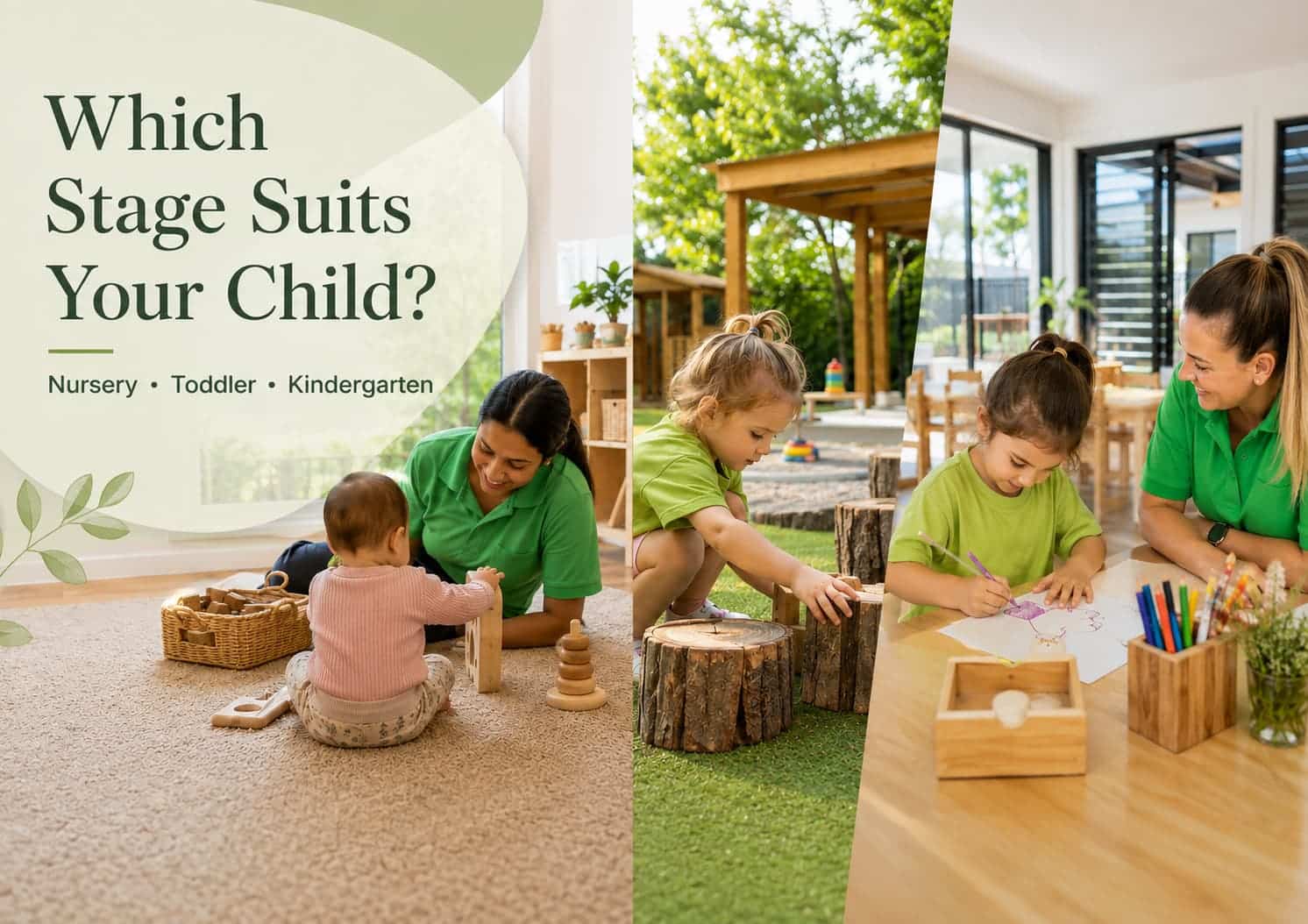
Nursery programs suit babies from approximately six weeks. Toddler programs suit children from aroun[...]

Quick answer The National Quality Framework (NQF) is Australia's national system for regulating a[...]