

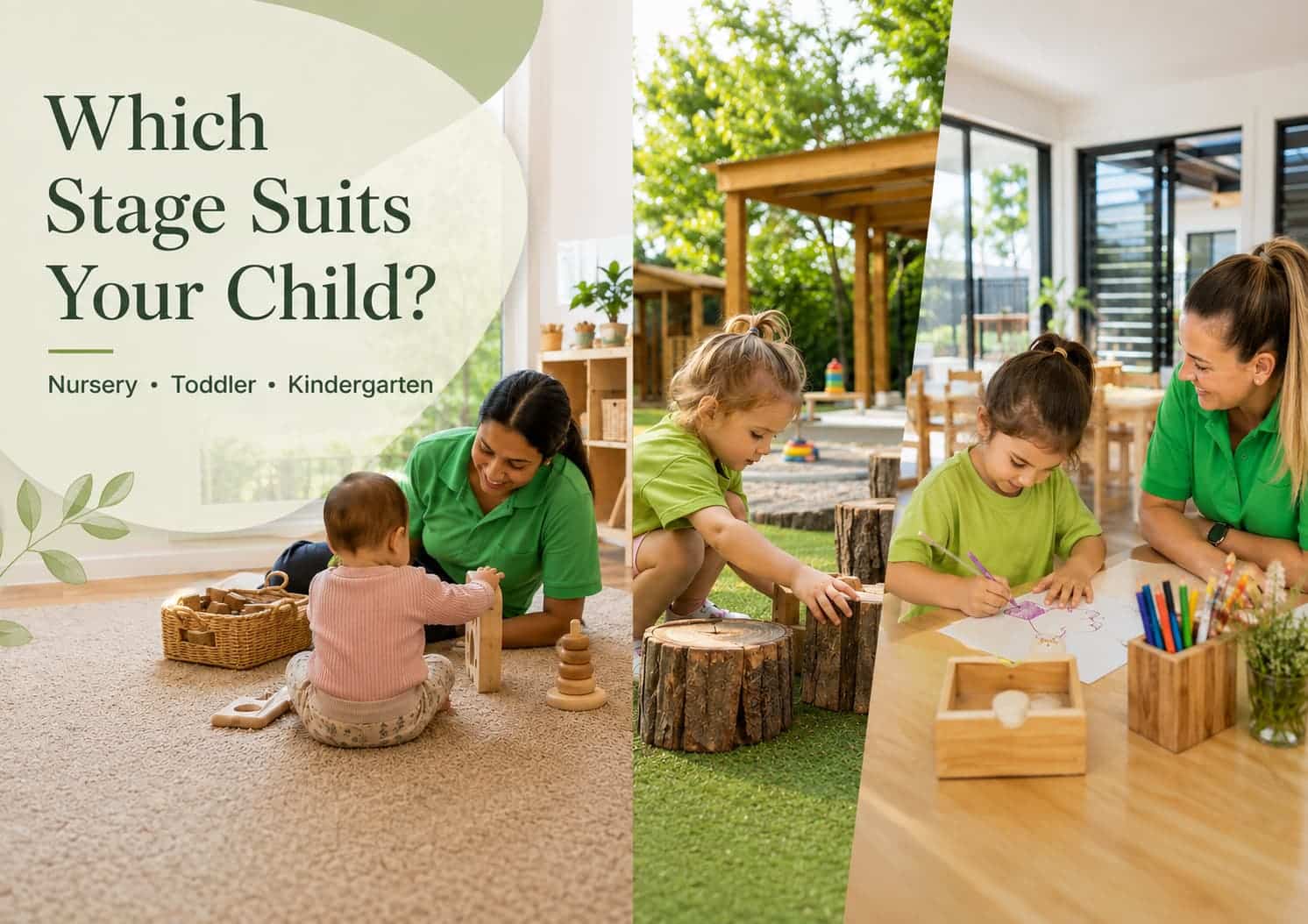
Nursery programs suit babies from approximately six weeks. Toddler programs suit children from around one to three years. Three-year-old kindergarten introduces structured group learning, and four-year-old kindergarten focuses on preparing children for primary school. All three share play-based learning as their foundation, so the right stage depends on your child’s age and developmental needs rather than a single readiness test.
Australian childcare centres group children into program stages based on age, with each stage matched to the educator-to-child ratios required by the National Quality Framework. The following table shows the standard program stages and the national minimum ratios that apply.
|
Age Group |
Typical Program Name |
National Minimum Ratio |
|---|---|---|
| Birth to around 12 months | Nursery or Babies | 1 educator to 4 children |
| Around 1 to 2 years | Walkers or Early Toddlers | 1 educator to 4 children |
| Around 2 to 3 years | Toddlers | 1 educator to 5 children |
| 3 to 4 years | Three-Year-Old Kindergarten | 1 educator to 11 children |
| 4 to 5 years | Four-Year-Old Kindergarten | 1 educator to 11 children |
These ratios are legal minimums set by the Education and Care Services National Regulations. Some providers choose to maintain lower ratios, meaning fewer children per educator and more individual attention. While room names vary between providers, most services follow this same age-based progression from babies through to kindergarten.
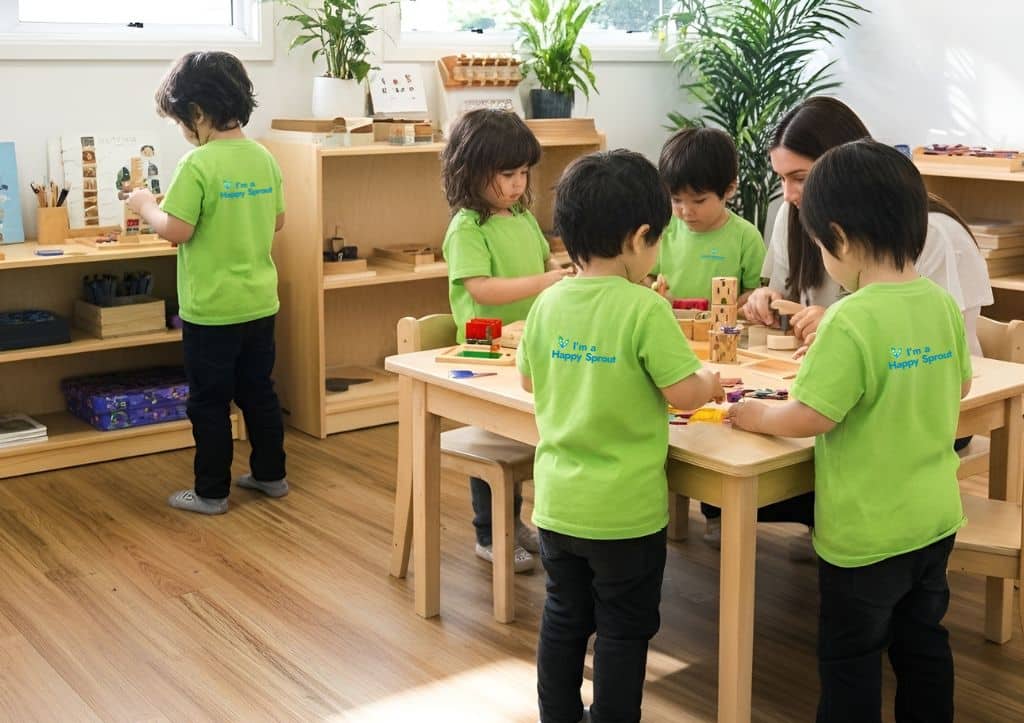
Play-based learning is the common approach across every stage. It means children develop skills through purposeful play rather than formal instruction. Educators set up learning environments that encourage children to explore, experiment and solve problems naturally. In Victoria, programs are guided by the Victorian Early Years Learning and Development Framework, which aligns with the national Early Years Learning Framework: Belonging, Being and Becoming.
Kindergarten (or kinder) is the Victorian term for structured early learning programs for three- and four-year-old children before primary school. Preschool is the term other Australian states use for the same stage. Pre-Prep is a Victorian Government initiative progressively expanding the funded hours available for four-year-old kindergarten. Despite the different names, these programs share the same goal: preparing children for school through play-based, educator-led learning. Read more about the difference between childcare and kindergarten.
A nursery program is the first stage of centre-based childcare, designed for babies from approximately six weeks to around 12 months. Nursery care focuses on secure attachment, consistent individual routines and sensory exploration rather than structured lessons. The national educator-to-child ratio for this age group is one educator to four children.
Babies learn by watching, listening, touching and moving. Educators create environments where these experiences happen naturally throughout the day, responding to each baby’s individual cues, feeding patterns and sleep needs.
Many centres use a parent communication app to share daily reports, photos and updates about feeding, sleep and activities. This gives parents visibility into their child’s day and supports the family-educator relationship that underpins quality nursery care.
Separation anxiety is a normal part of starting childcare, particularly for babies and younger toddlers. It is a healthy sign of attachment rather than a cause for concern. Consistent routines, familiar educators, gradual orientation sessions and clear goodbye rituals help children feel secure. If your child is unsettled during the early days, their educators can work with you on a settling plan that suits your child’s temperament.

Toddler programs are designed for children from approximately one to three years, focusing on independence, language development, movement, social interaction and creative play. This is one of the fastest periods of developmental change, and a quality toddler program creates space for children to explore, communicate and grow at their own pace.
Child-led learning means educators observe what interests each child and use those interests to plan future experiences. If a toddler is fascinated by water, for example, educators might extend that interest through pouring activities, water play outdoors or stories about rain and rivers. This supports deeper engagement because learning connects with what already matters to the child.
Educators combine child-led exploration with intentional experiences designed to extend skills and knowledge. They regularly reflect on what they observe, how children respond and what can be improved, adjusting individual learning plans to support each child’s progress.
Three-year-old kindergarten is a funded early learning program for children who turn three on or before 30 April of the kinder year. In Victoria, funded three-year-old kindergarten provides between five and 15 hours per week of structured group learning guided by the Victorian Early Years Learning and Development Framework. The focus is on communication, early literacy, early numeracy, social skills, creativity and curiosity, all delivered through play.
Three-year-old kindergarten is not compulsory in Victoria, but research consistently shows that two years of quality kindergarten before school leads to better learning and social outcomes. Three-year-old kinder helps children build the social confidence, communication skills and group learning habits that support a smoother transition into the four-year-old program. The Victorian Government funds two years of kindergarten through Free Kinder to give every child access regardless of family income.

Four-year-old kindergarten is a funded program for children who turn four on or before 30 April of the kinder year. In Victoria, the program provides 15 funded hours per week and must be delivered by a degree-qualified early childhood teacher. The focus extends beyond literacy and numeracy to include confidence, emotional readiness, communication, problem solving, resilience, self-regulation and the ability to work independently and as part of a group.
The key difference is intentional teaching. While both programs use play-based learning, four-year-old kindergarten adds planned learning experiences designed to extend children’s skills in targeted areas. A degree-qualified early childhood teacher leads the program, bringing specialist knowledge in child development, curriculum planning and school transition.
|
Area |
Three-Year-Old Kinder |
Four-Year-Old Kinder |
|---|---|---|
| Focus | Introduction to group learning | School readiness and transition |
| Funded hours (Victoria) | 5 to 15 hours per week | 15 hours per week |
| Teaching approach | Play-based, child-led | Play-based with intentional teaching |
| Lead educator | Diploma or degree-qualified | Degree-qualified early childhood teacher |
| Literacy and numeracy | Early exposure | Structured skill development |
| Social focus | Cooperation and sharing | Friendships, conflict resolution, independence |
School readiness is the combination of skills, confidence and behaviours a child needs to participate successfully in primary school. It includes social confidence, emotional regulation, communication, independence and the ability to participate in group learning — not just knowing letters and numbers. The Victorian Early Years Learning and Development Framework and the Early Years Learning Framework both define readiness as a broad developmental outcome rather than a narrow academic measure.
A quality kindergarten program develops all of these areas together. Educators work with families and often with local primary schools to support a smooth transition, which may include school visits and orientation activities.
Parents can support their child’s readiness through everyday activities. Formal teaching is not necessary; the focus is on building confidence, independence and social skills.

Children typically move between program rooms based on a combination of age, developmental readiness and individual needs rather than a fixed date. Most centres plan these transitions in consultation with families, using ongoing observations to determine when a child is ready for the next stage. Learn more about transitioning to childcare.
A thoughtful transition process includes several steps. Educators discuss the timing with families, arrange visits to the new room, introduce the child to their new educators and share information about routines, interests and developmental progress. Some children settle quickly, while others need more time and additional orientation sessions.
Every child develops at their own pace. Developmental milestones are useful guides, but they are not strict deadlines. A child who takes longer to reach a particular skill is not behind — they are developing on their own timeline.
Long day care kindergarten delivers the kinder program within a full-day childcare centre, so children attend kindergarten as part of a longer day of care. Sessional kindergarten is a standalone program for specific hours only. Both deliver the same funded Victorian kindergarten curriculum, but the fee structure, daily routine and Child Care Subsidy eligibility differ.
|
Feature |
Long Day Care Kindergarten |
Sessional Kindergarten |
|---|---|---|
| Setting | Kindergarten within a full-day childcare centre | Standalone kinder sessions only |
| Hours | Child attends full day; kinder hours included | Specific session times (e.g. 5 or 7.5 hours) |
| Continuity | Child stays in one centre from nursery through kinder | Separate enrolment; may involve different location |
| Free Kinder savings | Applied as a fee offset after CCS | Sessional program may have no out-of-pocket costs |
| CCS eligibility | Yes, for full-day attendance | CCS does not apply to sessional-only programs |
| Suits families who | Need full-day care and want kinder integrated | Want a kinder-only program for shorter hours |
Some providers offer both options, giving families flexibility to choose the arrangement that suits their work schedule, their child’s needs and their budget.
Victorian Free Kinder provides funded kindergarten for all three- and four-year-old children at participating services, regardless of family income, citizenship or visa status. Families do not need a Health Care Card or permanent residency to access Free Kinder. The Victorian Government funds the program directly through participating services.
The Child Care Subsidy (CCS) is an Australian Government payment that helps eligible families reduce the cost of approved childcare. The amount each family receives depends on household income, type of childcare and hours of recognised activity. CCS applies to centre-based long day care but does not apply to standalone sessional kindergarten. Families should check individual eligibility through Services Australia. For a detailed breakdown, see our guide to childcare costs and government subsidies in Victoria.
The right program depends on your child’s age, developmental stage, personality and your family’s practical needs. Visiting a centre in person is the most reliable way to assess the learning environment, meet the educators and see how children are cared for throughout the day.
Look for a centre that welcomes families from all backgrounds and abilities. Quality early learning services create inclusive environments where children from different cultures, languages and abilities learn and play together. This reflects the diverse communities across Melbourne’s northern suburbs and supports every child’s sense of belonging.
Nursery programs accept children from approximately six weeks of age. Nursery care focuses on secure attachment, individual routines and sensory exploration rather than structured learning. The national educator-to-child ratio for this age group is one educator to four children.
Nursery programs cater for babies and focus on individual care, feeding, sleep and sensory experiences. Toddler programs are designed for children from around one to three years and focus on growing independence, language development, social skills and active exploration. The ratio changes from one to four for babies to one to five for children over two.
Room transitions are based on a combination of age and developmental readiness, not a fixed date. Educators discuss the timing with families, arrange orientation visits and share information to make the transition smooth. Every child transitions at their own pace.
Research supports two years of kindergarten before school for better learning and social outcomes. Three-year-old kinder introduces children to group learning, builds social confidence and lays a foundation for the four-year-old program. In Victoria, Free Kinder funding makes it accessible to all families at participating services regardless of income.
Four-year-old kindergarten programs in Victoria must be delivered by a degree-qualified early childhood teacher. Other educators hold Certificate III or Diploma qualifications. These requirements are set by the National Quality Framework and monitored by ACECQA, the Australian Children’s Education and Care Quality Authority.
Long day care kindergarten is delivered within a full-day childcare centre. Sessional kinder is a standalone program for specific hours only. Both deliver the funded Victorian kindergarten curriculum, but families using long day care can also access the Child Care Subsidy for their full day of attendance, while sessional kinder may have no out-of-pocket costs under Free Kinder.
Nursery, toddler and kindergarten programs each support children at a specific point in their development. Nursery care builds secure attachment from six weeks. Toddler programs develop independence and language from one to three. Three-year-old kinder introduces group learning, and four-year-old kinder prepares children for primary school.
The most important thing is finding a centre where your child feels safe, supported and engaged. A centre tour gives you the chance to see the learning environments, meet the educators and ask the questions that matter most to your family.
Book a tour at your nearest Happy Sprouts Early Learning centre to see how each program stage supports your child’s learning and development. Happy Sprouts operates centres in Craigieburn, Beveridge and Greenvale, serving families across Melbourne’s northern suburbs with care and education from six weeks to six years.
Playgroup benefits for toddlers include stronger social skills, early language, emotional confidence[...]
Transition to school is the process of moving a child from kindergarten into the first year of prima[...]
Early childhood services are the regulated education and care options available for children from bi[...]
Quick answer The National Quality Framework (NQF) is Australia's national system for regulating a[...]
Childcare and kindergarten aren't the same thing. Childcare (or long day care) offers all-day [...]
Play is not a break from learning in early childhood; play is the learning. Play-based learning in e[...]